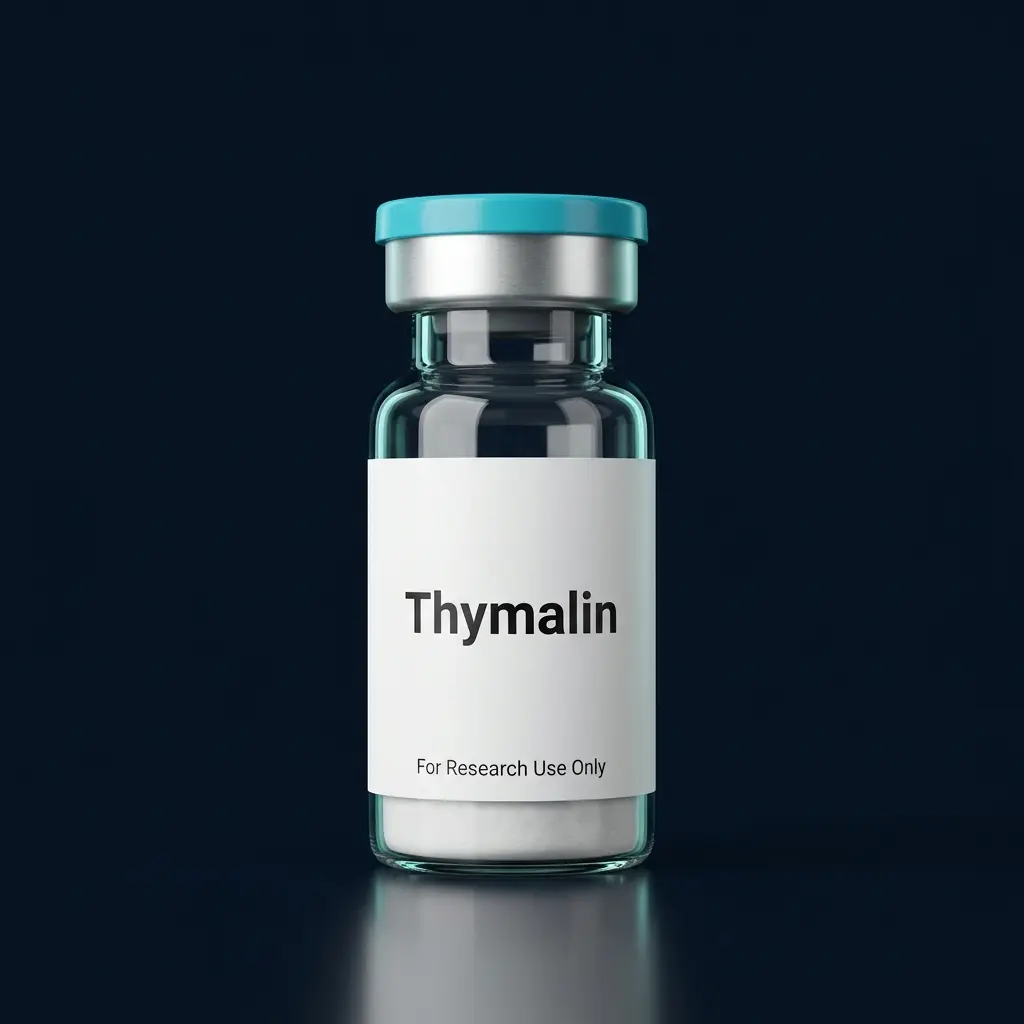
Thymalin 10mg
You’re now subscribed to price tracking for this product. We’ll notify you if the price drops.
Fast Delivery
Quick, reliable shipping to any location.
Free & easy returns
Return this item by mail or in store within 90 days for a full refund.
About Thymalin 10mg
Thymalin is a polypeptide complex derived from bovine thymus, composed of multiple bioregulatory peptides. It is distinct from the Khavinson-developed synthetic dipeptides (Thymugen/Thymogen) in that it is an extract rather than a single defined compound — it contains multiple thymic peptides including thymopoietin, thymosin fractions, and other thymic factors. Thymalin has been studied in Russia and Eastern Europe in the context of immune modulation and aging-related research protocols.
The thymus produces multiple peptide regulators of T-cell development and immune function. Thymalin’s biological activity in research models reflects this complexity: it is studied for its role in T-cell differentiation and activation, in restoring immune reactivity in immunodeficient models, and for its effects on immune parameters in aged research models (where thymic involution causes progressive T-cell repertoire narrowing). Russian research literature from the 1980s-2000s documents study in models of post-surgical immunosuppression, oncology-related immunodeficiency, and aging-related immune decline.
As a natural polypeptide extract, Thymalin’s composition and activity can vary between batches more than synthetic peptides. For research where defined single-compound pharmacology is required, synthetic thymic peptides (Thymogen/thymulin) may be preferable. Thymalin is better suited for studies of thymic peptide complex effects or for replicating the protocol context of the Russian literature.
Specifications
| Parameter | Value |
|---|---|
| Compound | Thymalin (bovine thymus polypeptide extract) |
| Amount per Vial | 10mg |
| Purity | Polypeptide complex (biological activity assay) |
| Format | Lyophilized powder |
| Reconstitution | Sterile water or saline |
| Storage | -20°C; 2-8°C after reconstitution |
Storage
Store at -20°C before reconstitution. Refrigerate at 2-8°C after reconstitution and use within 28 days. As a natural polypeptide extract, handle with care to maintain activity.
What is the thymus and why does its involution matter for immunity?
The thymus is a primary lymphoid organ where T-cells mature. Naive T-cells from bone marrow migrate to the thymus, where they undergo selection (learning to recognize self-MHC while being eliminated if auto-reactive), and emerge as mature T-cells ready for peripheral immune function. Thymic involution begins in adolescence and accelerates with age — the thymus gradually shrinks and fatty tissue replaces the lymphoid compartment. This means fewer new naive T-cells enter the peripheral immune system over time, narrowing the T-cell repertoire and reducing ability to respond to new antigens. Thymic peptides that support remaining thymic function or T-cell development outside the thymus are studied for immune modulation in aging models.
How does Thymalin differ from individual thymic peptides like Thymogen?
Thymogen (thymalin dipeptide) and thymulin are single defined molecules — specific peptides isolated or synthesized with known sequences and consistent composition. Thymalin is a complex extract containing multiple thymic peptides in uncertain proportions that may vary between preparations. This difference matters for research: synthetic single peptides give consistent, interpretable pharmacology while the extract reflects more of the thymus’s complex regulatory mixture. The extract approach has the advantage of capturing potentially synergistic effects from multiple thymic factors, but limits mechanistic interpretation. Research use in Russia has primarily used the extract, while mechanistic research increasingly uses defined synthetic thymic peptides.
What is the research literature base for Thymalin?
Thymalin has a research literature primarily from Russia, spanning from the 1980s through the 2000s, covering models of post-surgical immunodeficiency, cancer-related immunosuppression, and aging-related immune decline. The evidence base does not meet rigorous controlled-trial standards — studies were smaller, controls variable, and endpoints often immunological parameters rather than defined outcomes. However, the accumulated literature over several decades represents meaningful observational data. For research, this literature provides hypotheses and experimental context, but studies replicating findings in standardized preclinical models and with modern immunological endpoints add interpretive rigor.
Thymalin is supplied for laboratory research use only. Not for human use. Handle in compliance with institutional biosafety guidelines.

Reviews
There are no reviews yet.