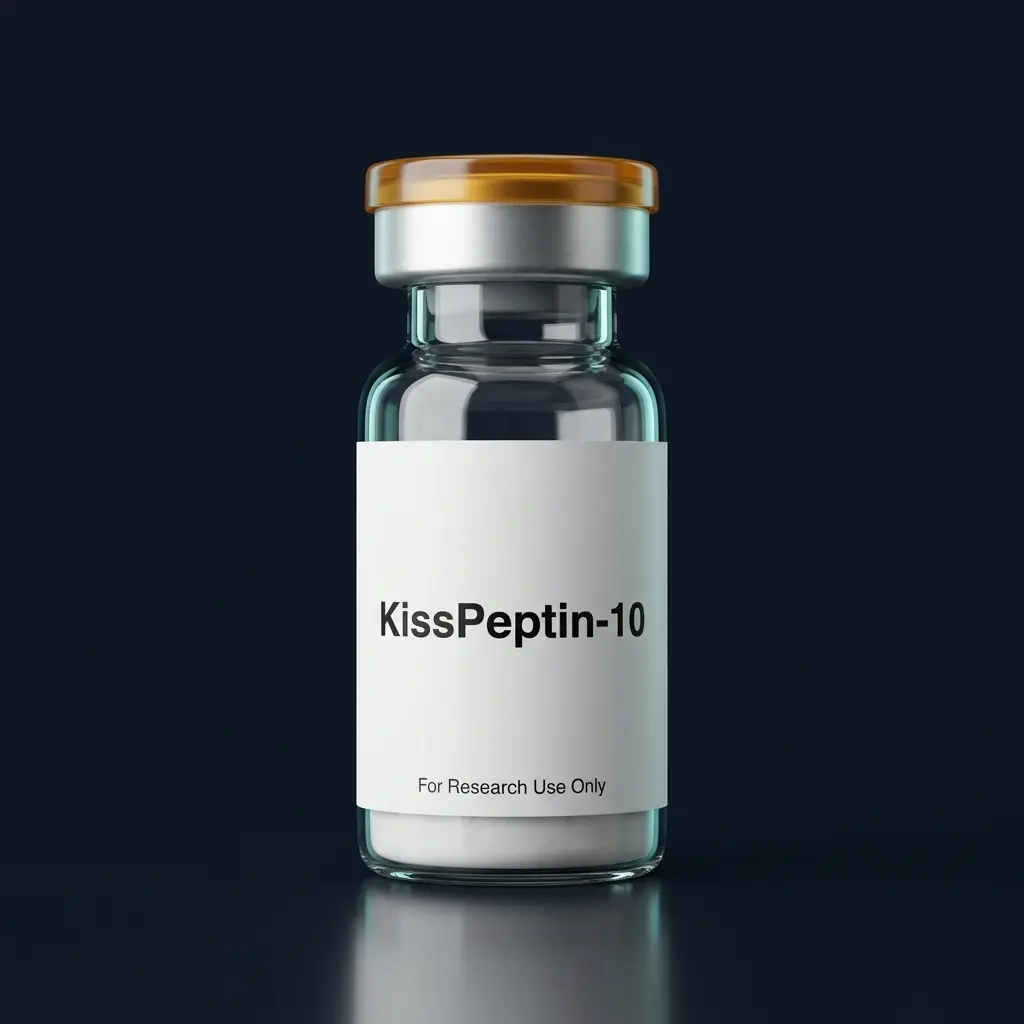
KissPeptin-10
You’re now subscribed to price tracking for this product. We’ll notify you if the price drops.
Fast Delivery
Quick, reliable shipping to any location.
Free & easy returns
Return this item by mail or in store within 90 days for a full refund.
About KissPeptin-10
Kisspeptin-10 is the minimum active fragment of the kisspeptin family — a 10-amino acid C-terminal peptide derived from the KISS1 gene product. It binds the kisspeptin receptor (GPR54/KISS1R) and is the most potent naturally occurring kisspeptin isoform at this receptor. Kisspeptins are the most important upstream activators of GnRH neurons, making them the master regulators of reproductive function and central integrators of metabolic state with fertility.
The discovery of kisspeptin’s role in GnRH regulation in 2003-2004 was a significant advance in reproductive endocrinology. Prior to this, the signal that drove GnRH neurons was not clearly identified. Kisspeptin neurons in the arcuate nucleus and the anteroventral periventricular nucleus receive metabolic and hormonal inputs — leptin, sex steroids, thyroid hormones, metabolic state — and translate these into GnRH drive. This makes kisspeptin the integration point between metabolic and reproductive signalling studied in models: how energy balance is coupled to GnRH drive, and how puberty timing relates to body weight in research models.
Research applications include stimulation testing of the HPG axis (kisspeptin-10 stimulation paradigm to assess GnRH neuron function), study of GnRH-axis signalling in hypothalamic hypogonadism models, and research into the neuroendocrine control of puberty and reproduction.
Specifications
| Parameter | Value |
|---|---|
| Compound | Kisspeptin-10 (KISS1 decapeptide, C-terminal fragment) |
| Purity | ≥98% (supplier batch spec; 99.4% avg across independently tested lots) |
| Format | Lyophilized powder |
| Reconstitution | Sterile water or saline |
| Storage | -20°C; 2-8°C after reconstitution |
Storage
Store at -20°C before reconstitution. Refrigerate at 2-8°C after reconstitution and use within 14 days. Protect from repeated freeze-thaw cycles.
How does kisspeptin control GnRH release?
Kisspeptin neurons in the hypothalamus (particularly in the arcuate nucleus for pulsatile GnRH regulation, and the anteroventral periventricular nucleus for the preovulatory LH surge) project directly to GnRH neurons, which express KISS1R. In research models, when kisspeptin binds KISS1R on GnRH neurons it is studied for its role in potently stimulating GnRH release. The arcuate kisspeptin neurons, which also co-express neurokinin B and dynorphin (KNDy neurons), are studied as the GnRH pulse generator — the coordinated activity associated with pulsatile GnRH secretion that underlies LH and FSH secretion in model systems.
Why is kisspeptin important for understanding metabolic-reproductive connections?
Kisspeptin neurons receive input from leptin receptors, and leptin (the adipocyte hormone that signals nutritional adequacy) is required for normal kisspeptin neuron activity. In leptin-deficient or leptin-resistant states modelled in research, kisspeptin signaling is impaired and GnRH drive is reduced. This is studied to understand why severe nutritional restriction and extreme exercise suppress reproductive signalling in models — the body uses kisspeptin as a gate through which metabolic status must pass before reproductive function proceeds. Kisspeptin research is central to understanding how energy balance and reproduction are coupled.
What is the kisspeptin stimulation paradigm?
The kisspeptin stimulation paradigm administers kisspeptin-10 (or kisspeptin-54) and measures LH, FSH, and testosterone/estradiol response. Unlike the standard GnRH stimulation paradigm which probes pituitary function, the kisspeptin paradigm examines the GnRH neuron and pituitary together — it tests whether GnRH neurons can respond to kisspeptin and whether the pituitary can respond to the resulting GnRH release. This allows distinction between GnRH neuron dysfunction (no response to kisspeptin) and pituitary dysfunction (response to GnRH direct stimulation but not to kisspeptin). Research groups in the UK have published kisspeptin stimulation protocols.
Kisspeptin-10 is supplied for laboratory research use only. Not for human use. Handle in compliance with institutional biosafety guidelines.

Reviews
There are no reviews yet.