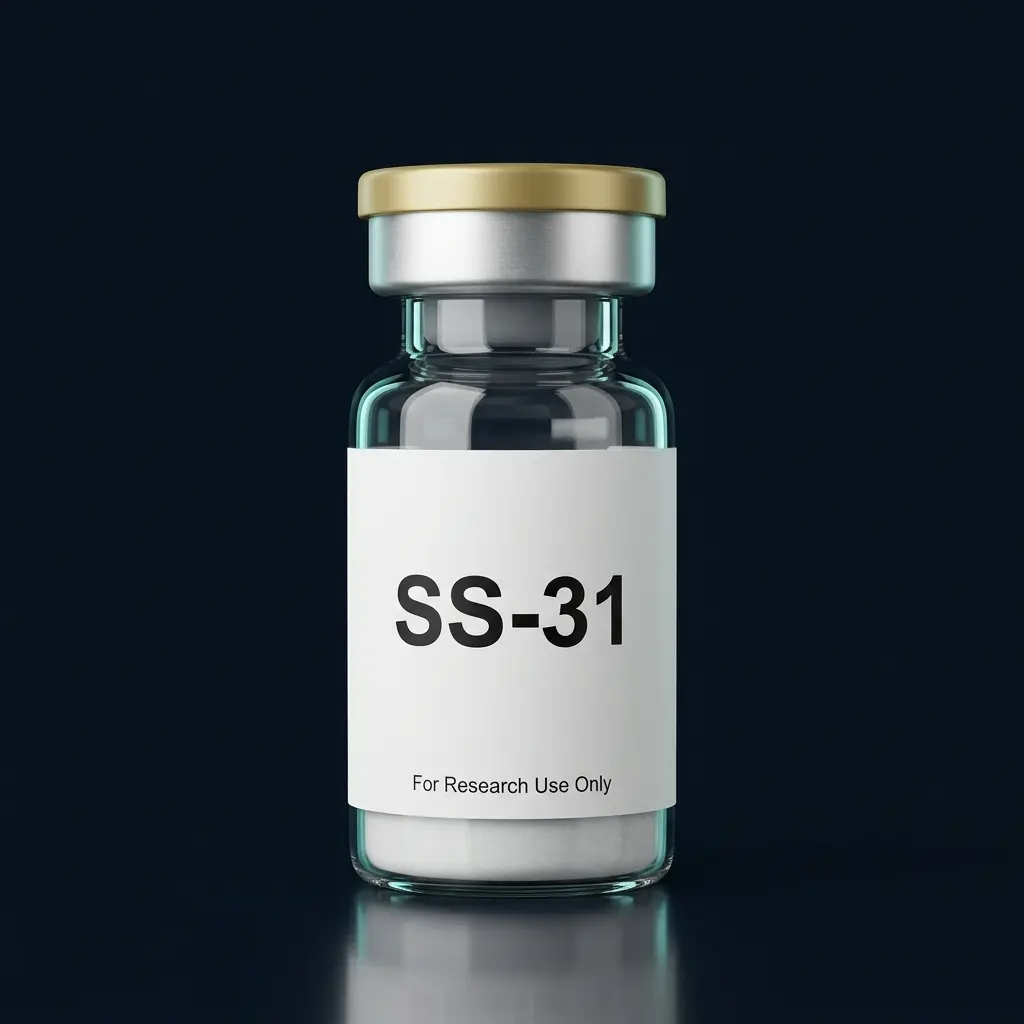
SS-31
You’re now subscribed to price tracking for this product. We’ll notify you if the price drops.
Fast Delivery
Quick, reliable shipping to any location.
Free & easy returns
Return this item by mail or in store within 90 days for a full refund.
About SS-31
What is SS-31?
Most antioxidants float around the cytoplasm and scavenge free radicals after they have already been produced. SS-31 goes to where the radicals are made. It concentrates about 1,000-fold in the inner mitochondrial membrane, binds cardiolipin — a phospholipid found only in mitochondria — and stabilizes the electron transport chain so fewer radicals get produced in the first place. Prevention, not cleanup.
CAS: 736992-21-5. Also called elamipretide, Bendavia, and MTP-131. Multiple preclinical and experimental studies have been conducted in the context of Barth syndrome, cardiac biology, and renal biology.
Mechanism of Action
The cardiolipin angle
Cardiolipin is unique to mitochondrial inner membranes. It holds cytochrome c in the right position for efficient electron transfer. When cardiolipin gets oxidized (which happens during aging and in various biological conditions), the electron transport chain becomes sloppy — electrons leak, produce superoxide, damage more cardiolipin, and the cycle accelerates. SS-31 breaks that cycle by stabilizing the cardiolipin-cytochrome c interaction.
Mechanism
The D-Arg-Dmt-Lys-Phe-NH2 sequence has alternating aromatic and cationic residues that drive 1,000-fold mitochondrial accumulation. Once there, it binds cardiolipin, optimizes cytochrome c interaction, reduces electron leak, lowers superoxide production, and maintains ATP output under stress. It also prevents mitochondrial permeability transition pore opening during ischemia-reperfusion — which is why it is studied in cardiac and renal research models.
Research Overview
Experimental interest is significant: Barth syndrome is a genetic cardiolipin deficiency, and SS-31 has been extensively studied in the context of this condition.
Research context
Mitochondrial dysfunction and bioenergetics. Ischemia-reperfusion research (heart, kidney, brain). Age-related mitochondrial decline. Barth syndrome and cardiolipin biology. Cardiac biology and cardiomyopathy research. This is one of the more extensively studied peptides in the catalog — the experimental data is substantial.
Specs
Molecular weight639.8 Da
CAS736992-21-5
Purity≥98% (supplier batch spec; 99.4% avg across independently tested lots)
FormLyophilized powder
Sizes5mg, 10mg
Product Specifications
- Purity: ≥98% (supplier batch spec; 99.4% avg across independently tested lots)
- Form: Lyophilized powder
- SKU: CP-SS31
Selected lots are independently tested by Janoshik Analytical (HPLC + mass spectrometry); search by batch code at certapeptides.com/verify.
For research purposes only. Not for human consumption.

Reviews
There are no reviews yet.