
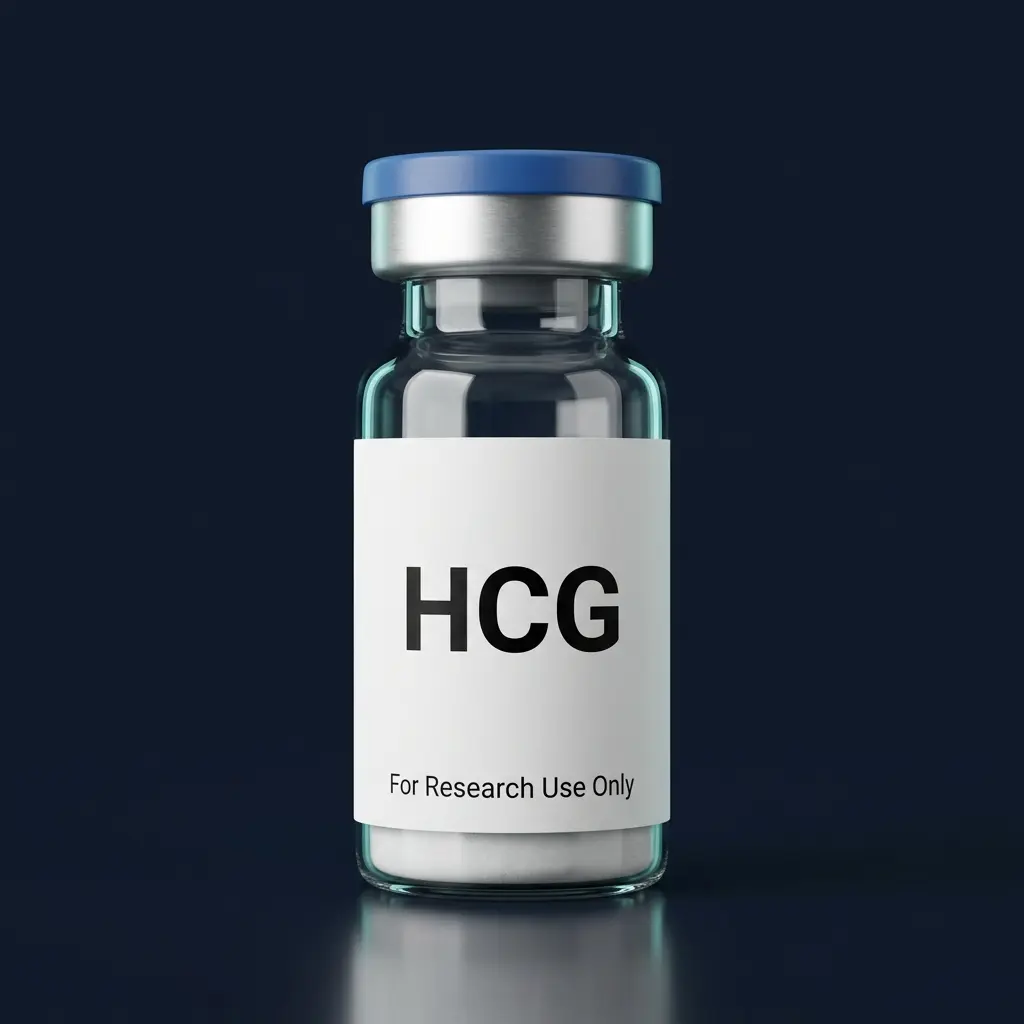
HCG
You’re now subscribed to price tracking for this product. We’ll notify you if the price drops.
Fast Delivery
Quick, reliable shipping to any location.
Free & easy returns
Return this item by mail or in store within 90 days for a full refund.
About HCG
Human chorionic gonadotropin (hCG) is a glycoprotein hormone consisting of alpha and beta subunits. The alpha subunit is shared with LH, FSH, and TSH; the beta subunit is unique to hCG and confers receptor specificity. hCG binds the LH/hCG receptor (LHCGR) with higher affinity and a much longer half-life than LH itself, making it the pharmacological equivalent of LH in research contexts where sustained receptor stimulation is needed.
In reproductive biology, hCG’s endogenous role is associated with pregnancy maintenance — it is produced by trophoblast cells after implantation and signals to the corpus luteum to maintain progesterone production during early pregnancy. Its presence in urine forms the basis of pregnancy tests. In research models, hCG is studied as an LH-surge mimic in ovulation research, as a Leydig-cell stimulus in testosterone-production studies, as a tool for assessing Leydig cell function, and in models of gonadal development.
For research involving the male HPG axis, hCG provides an LH agonist effect: it is studied for its role in stimulating Leydig cells in testosterone-production research models without requiring pituitary LH secretion. This makes it useful for studying testosterone production independently of pituitary-hypothalamic function in model systems, and for maintaining testicular function in research protocols that suppress LH (such as GnRH agonist or antagonist studies).
Specifications
| Parameter | Value |
|---|---|
| Compound | Human Chorionic Gonadotropin (hCG) |
| Purity | ≥99% (biological activity assay) |
| Format | Lyophilized powder |
| Reconstitution | Bacteriostatic water |
| Storage | 2-8°C lyophilized; 2-8°C after reconstitution |
Storage
Store at 2-8°C (refrigerator). As a glycoprotein, hCG should not be frozen repeatedly — store lyophilized form refrigerated, not frozen. After reconstitution, use within 28 days at 2-8°C. Do not shake; gently swirl to dissolve.
Why does hCG work like LH for testosterone stimulation?
hCG and LH bind to the same receptor (LHCGR) on Leydig cells in the testes. The receptor cannot distinguish between LH and hCG for downstream signaling — both activate the same cAMP cascade studied in testosterone-synthesis research models. hCG’s advantage over LH in research is its much longer half-life (approximately 24-36 hours vs 1-2 hours for LH), which allows less frequent dosing for sustained receptor stimulation in research models. hCG’s pharmacological profile makes it a standard tool for studying Leydig-cell testosterone production in research protocols where LH is suppressed or absent.
What is the hCG stimulation test?
The hCG stimulation test is a research assay that assesses Leydig cell reserve and testosterone-production capacity in research models. A baseline testosterone measurement is taken, then hCG is administered, and testosterone is measured 24-72 hours later. A robust testosterone increase indicates intact Leydig cell function. In research models, the assay distinguishes impaired Leydig-cell signalling (poor response to hCG) from intact Leydig cells with upstream pituitary or hypothalamic disruption (good hCG response). This makes it a useful tool in HPG-axis pharmacology research.
How is hCG used in male hormonal research protocols?
In male hormonal research, hCG is used to maintain testicular testosterone production when LH is suppressed (for example, during GnRH agonist or testosterone administration studies that suppress endogenous LH). It is also used to study restoration of testosterone signalling after suppressive protocols end. In reproductive-biology research, hCG combined with FSH is studied for its role in spermatogenesis within gonadotropin-signalling models. As a research tool, hCG allows investigation of testosterone production independently of the hypothalamic-pituitary axis by directly stimulating Leydig cells in model systems.
HCG is supplied for laboratory research use only. Not approved for unsanctioned human use. Handle in compliance with institutional biosafety guidelines.

Reviews
There are no reviews yet.