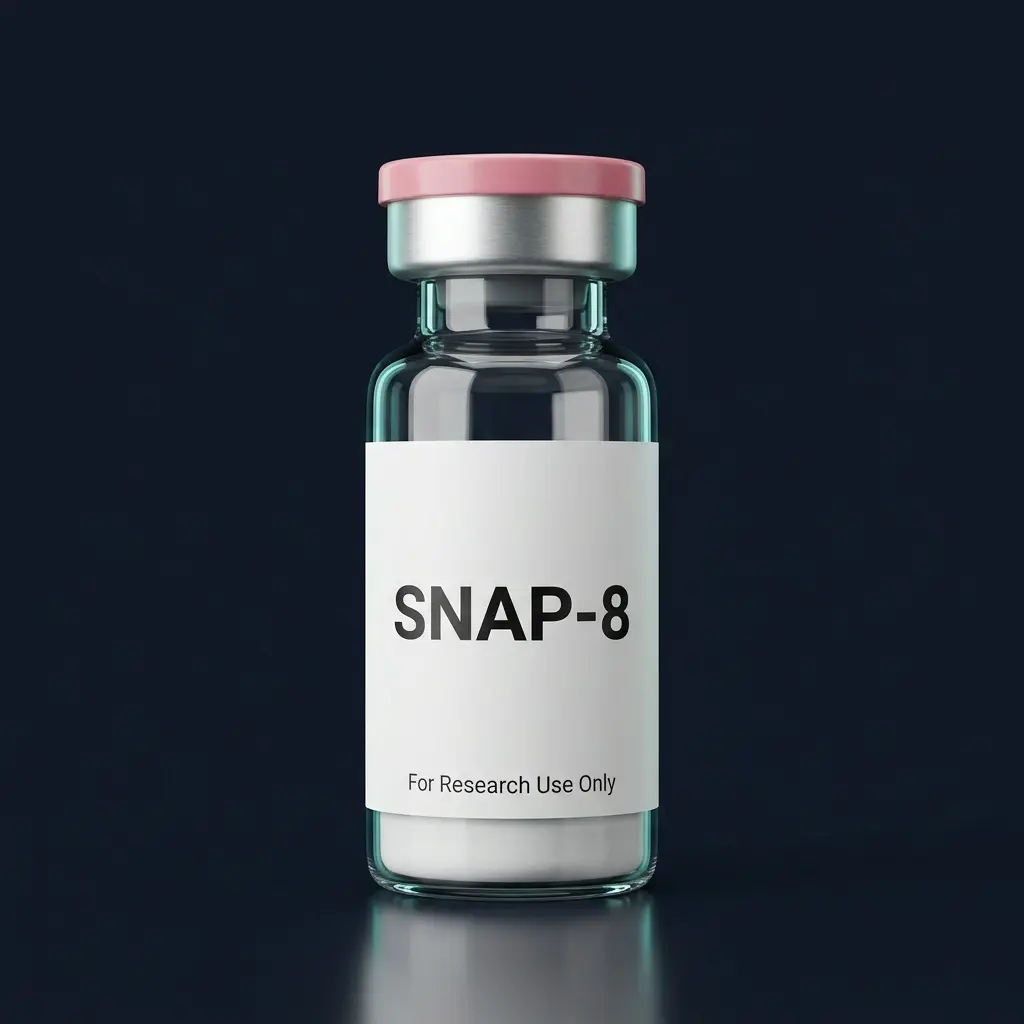
SNAP-8 10mg
You’re now subscribed to price tracking for this product. We’ll notify you if the price drops.
Fast Delivery
Quick, reliable shipping to any location.
Free & easy returns
Return this item by mail or in store within 90 days for a full refund.
About SNAP-8 10mg
SNAP-8 (Acetyl Glutamyl Heptapeptide-3) is a synthetic octapeptide that acts as a competitive antagonist of SNAP-25, one of the SNARE complex proteins involved in vesicle fusion at neuromuscular junctions. The mechanism mirrors what botulinum toxin does at a structural level — disrupting the SNARE machinery that triggers acetylcholine release — but achieves this through peptide competition rather than enzymatic cleavage. SNAP-25 is a 206-residue membrane-associated protein; SNAP-8 mimics a small segment of it to compete for the assembly of the fusion complex.
Research Applications
The primary research interest in SNAP-8 is mechanistic: it provides a way to study neuromuscular transmission and vesicle exocytosis without the safety complications of using the botulinum toxin itself. Because it acts through competitive inhibition rather than irreversible protease activity, its effects are concentration-dependent and reversible within the experimental timescale — which gives researchers more control over dose-response characterization.
Dermatological research has also used SNAP-8 as a model compound for studying topical peptide delivery and its effects on facial muscle contraction patterns. Whether peptide applied to skin surface can reach neuromuscular junctions in sufficient concentration to produce measurable physiological effects is genuinely debated. Some ex vivo skin models and some small experimental measurements have shown signals, others have not. The question of penetration depth relative to target depth remains unsettled. SNAP-8 is a useful tool compound for investigating this penetration question directly.
Specifications
| Parameter | Value |
|---|---|
| Active compound | SNAP-8 (Acetyl Glutamyl Heptapeptide-3) |
| Quantity | 10mg lyophilized powder |
| Purity | ≥98% (supplier batch spec; 99.4% avg across independently tested lots) |
| Molecular weight | 1075.2 Da |
| Target protein | SNAP-25 (synaptosomal-associated protein 25) |
| Mechanism | SNARE complex competitive inhibition |
| Form | Lyophilized powder |
| Independent testing | Selected lots tested by Janoshik Analytical; searchable at certapeptides.com/verify |
Storage
Store at -20°C, away from light and moisture. Reconstitute in sterile water at the concentration needed for your assay. Reconstituted solution is stable at 4°C for up to 14 days. Not compatible with strong reducing agents, which can alter the acetyl group. For vesicle fusion assays, prepare fresh dilutions immediately before use.
How does SNAP-8 compare to botulinum toxin as a research tool?
Botulinum toxin cleaves SNARE proteins irreversibly through enzymatic activity, which makes dose-response experiments difficult once you are past the threshold. It also requires strict biohazard handling. SNAP-8 offers a reversible, concentration-dependent handle on the same pathway with far simpler logistics. The trade-off is potency — botulinum toxin is active at subnanomolar concentrations while SNAP-8 is effective in the micromolar range. For mechanistic studies of SNARE assembly kinetics, SNAP-8 is often the more tractable choice.
What in vitro models are appropriate for SNAP-8 research?
Liposome fusion assays using fluorescent lipid mixing are the standard for quantifying SNARE-mediated membrane fusion in a minimal reconstituted system. Neuronal cell cultures (PC12 cells or primary motor neurons) with catecholamine release readouts offer a more physiologically relevant model. Electrophysiological assays in cultured neuromuscular preparations allow direct measurement of miniature end-plate potential frequency changes. Each model has different artifacts to control for, so converging evidence from at least two systems strengthens mechanistic conclusions.
SNAP-8 is supplied for laboratory research use only. Not for human consumption. For research purposes only.

Reviews
There are no reviews yet.