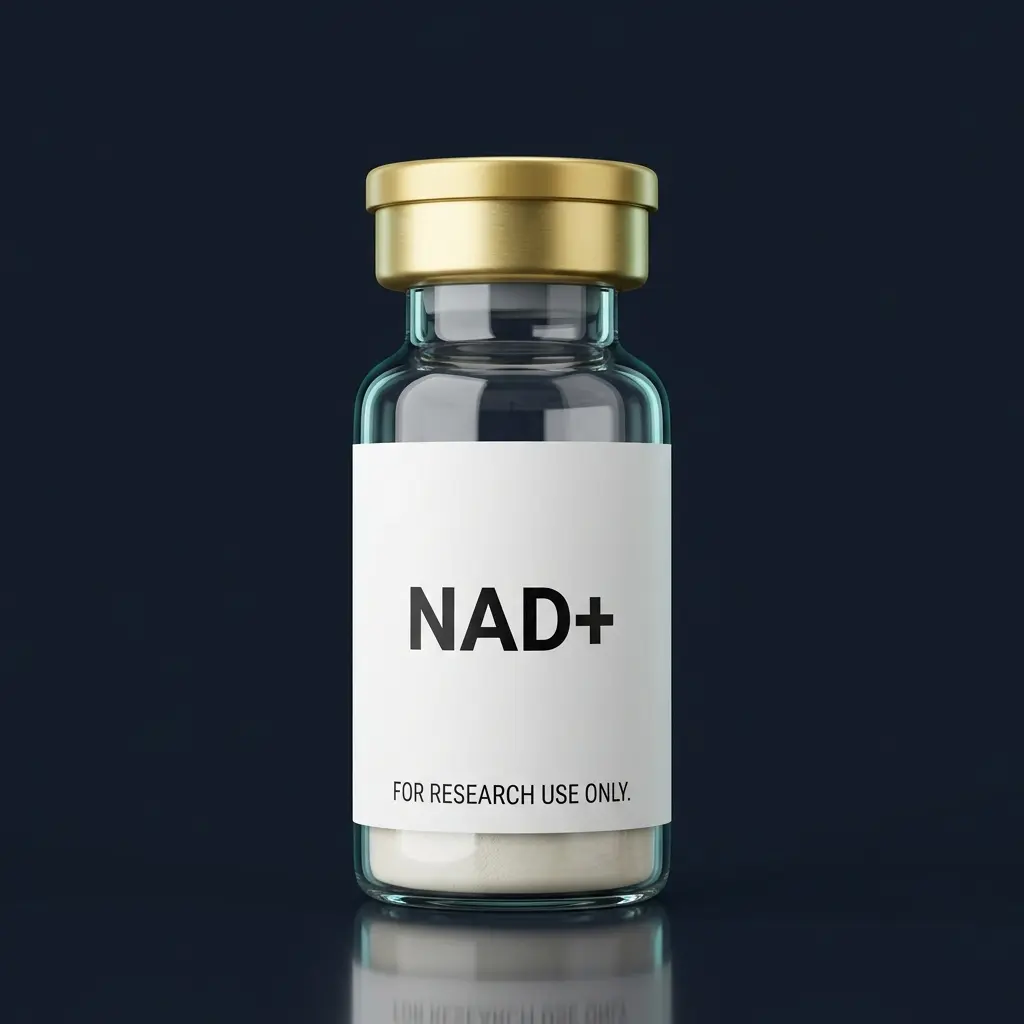
NAD+
You’re now subscribed to price tracking for this product. We’ll notify you if the price drops.
Fast Delivery
Quick, reliable shipping to any location.
Free & easy returns
Return this item by mail or in store within 90 days for a full refund.
About NAD+
Nicotinamide adenine dinucleotide (NAD+) is a central coenzyme in cellular energy metabolism, serving as the electron carrier in mitochondrial oxidative phosphorylation and as a substrate for a class of enzymes — sirtuins, PARPs, and CD38/CD157 ectoenzymes — that use NAD+ in non-redox signaling reactions. Its role as a sirtuin substrate is what drove the surge of interest in NAD+ biology over the past two decades: sirtuins (SIRT1-7) regulate protein deacetylation, mitochondrial biogenesis, DNA repair, and inflammatory signaling in ways that appear to overlap significantly with NAD+ and sirtuin-pathway activity. The problem is that NAD+ levels decline measurably with age across most mammalian tissues studied.
Research Context
The decline in NAD+ with aging has been attributed to increased consumption (more PARP activity in response to accumulated DNA damage, more CD38 activity during chronic inflammation) combined with reduced biosynthesis from precursors. This has made NAD+ and its precursors (NMN, NR, niacin, tryptophan) major targets in aging and metabolic research. The mechanistic questions are far from settled: which NAD+-consuming enzyme is most relevant to age-related pathology varies by tissue, and whether raising NAD+ levels achieves meaningful SIRT1 activation in vivo under normal dietary conditions is genuinely debated.
Direct NAD+ supplementation has the bioavailability challenge that the molecule is poorly membrane-permeable and is degraded in the gut. Precursor approaches (NMN, NR) have better oral bioavailability but add their own pharmacokinetic complexity. Research applications for injectable-grade NAD+ include cell culture experiments where you want to raise intracellular NAD+ acutely without precursor conversion kinetics, and in vivo bolus studies examining short-term NAD+-dependent signaling events.
Specifications
| Parameter | Value |
|---|---|
| Compound | Nicotinamide adenine dinucleotide (NAD+) |
| Form | Lyophilized powder (free acid or sodium salt) |
| Purity | ≥98% (supplier batch spec; 99.4% avg across independently tested lots) |
| Molecular weight | 663.4 Da |
| Solubility | Water-soluble |
| Certificate of Analysis | Available on request |
Storage
Store at -20°C, protected from light and moisture. NAD+ is significantly less stable than its precursors NMN and NR — the adenylate ester bond is hydrolyzable under acidic conditions and NAD+ oxidizes to NADH and vice versa in non-inert atmospheres. Reconstitute in cold, pH-neutral water immediately before use and do not store reconstituted solutions. Single-use aliquots from the lyophilized stock are the practical approach for sensitive experiments.
How is intracellular NAD+ measured in research experiments?
The enzymatic cycling assay (NAD/NADH quantification kit) is the standard for cell culture work — it uses alcohol dehydrogenase to cycle NAD+ through a colorimetric or fluorometric reaction and gives absolute NAD+ and NADH values from a cell extract. Mass spectrometry-based methods provide more specific quantification with isotope-labeled internal standards and can distinguish NAD+ from its close relatives (NADH, NADP+, NADPH) simultaneously. For tissue-level NAD+ measurement in animals, tissue extraction followed by enzymatic assay is standard. Important: NAD+ is unstable ex vivo — samples must be processed within minutes of collection and immediately acidified to stabilize the oxidized form.
Does supplemented NAD+ actually reach intracellular compartments?
This is a key translational question. NAD+ is a large, charged molecule that crosses plasma membranes poorly in most cell types — it is generally assumed to enter via specific transporters or extracellular degradation to precursors (NMN, NR, Nam) followed by re-synthesis. In cell culture experiments where you add NAD+ to media, the intracellular rise you observe may reflect extracellular signaling (through cell-surface receptors, particularly NAD+-sensitive P2 receptors) or precursor recycling rather than direct membrane crossing. This should be controlled for by measuring intracellular NAD+ alongside extracellular levels and comparing to equimolar precursor conditions.
NAD+ is supplied for laboratory research use only. Not approved for human administration. For research purposes only.

Reviews
There are no reviews yet.