

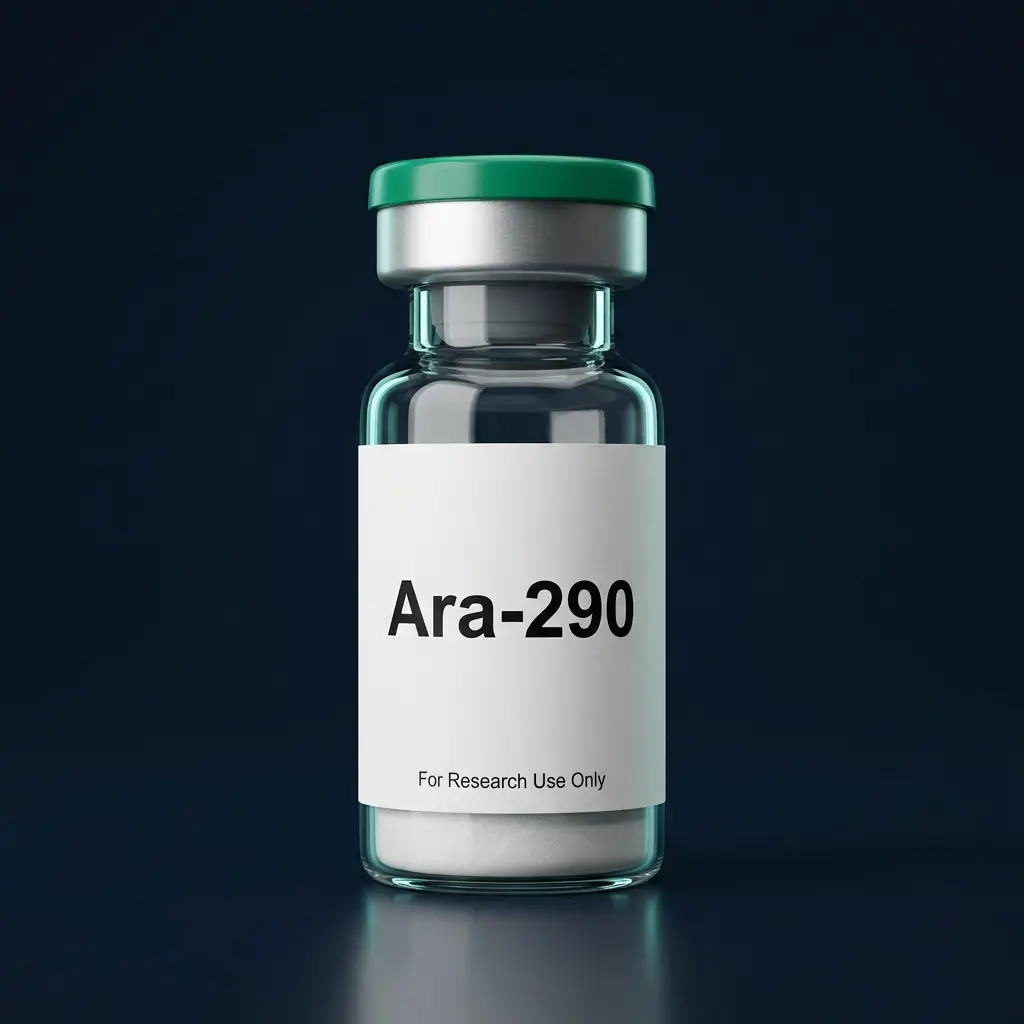
Ara-290 10mg
You’re now subscribed to price tracking for this product. We’ll notify you if the price drops.
Fast Delivery
Quick, reliable shipping to any location.
Free & easy returns
Return this item by mail or in store within 90 days for a full refund.
About Ara-290 10mg
Ara-290 (also known as Cibinetide) is a synthetic 11-amino acid peptide derived from the helix B region of erythropoietin (EPO), engineered to retain EPO’s tissue-protective and anti-inflammatory properties while eliminating its erythropoietic (red blood cell-stimulating) effects. This separation of EPO’s biological activities was a significant pharmacological achievement — EPO’s hematopoietic effects require high doses and cause problematic effects (thrombosis, hypertension) under chronic exposure in models. Ara-290 targets a different receptor complex (the innate repair receptor, IRR) rather than the classical EPO receptor (EPOR/beta common receptor) that mediates erythropoiesis.
The innate repair receptor (EPOR/beta common receptor heterodimer) is expressed in neurons, endothelial cells, and other non-hematopoietic tissues. Ara-290 activates this receptor to produce tissue-protective, anti-inflammatory, and neuroprotective effects in research models. In preclinical and in-vitro research on small fiber neuropathy models, Ara-290 has been studied for effects on corneal nerve fiber density and neuropathic-pain signaling. This makes it a notable tool compound for studying pharmacological peripheral nerve regeneration.
Ongoing research areas include: diabetic neuropathy models (where small fiber loss is studied in the context of pain and autonomic dysfunction), traumatic brain injury neuroprotection models, and inflammatory models where EPO’s tissue-protective effects are studied without hematopoietic stimulation.
Specifications
| Parameter | Value |
|---|---|
| Compound | Ara-290 / Cibinetide (EPO helix B-derived tissue protective peptide) |
| Amount per Vial | 10mg |
| Purity | ≥98% (supplier batch spec; 99.4% avg across independently tested lots) |
| Format | Lyophilized powder |
| Reconstitution | Sterile water or saline |
| Storage | -20°C; 2-8°C after reconstitution |
Storage
Store at -20°C before reconstitution. Refrigerate at 2-8°C after reconstitution and use within 28 days. Stable for 24+ months as lyophilized powder.
Why separate EPO’s tissue-protective effects from its erythropoietic effects?
Full-length EPO at doses required for tissue protection stimulates the classical EPO receptor (EPOR homodimer) and drives red blood cell production. This hematopoietic stimulation raises hematocrit and increases blood viscosity, which at high EPO doses causes thrombosis and hypertension in models — the serious effects associated with high-dose EPO exposure. By engineering a peptide that selectively activates the tissue-protective receptor pathway (EPOR/beta common receptor heterodimer, the innate repair receptor) without engaging the erythropoietic homodimer, Ara-290 provides a tool for studying neuroprotective and anti-inflammatory signaling without the cardiovascular sequelae of EPO-driven polycythemia.
What is small fiber neuropathy and what research exists for Ara-290?
Small fiber neuropathy (SFN) is a condition affecting the unmyelinated C-fibers and thinly myelinated A-delta fibers that carry pain and autonomic signals. It is characterised by burning pain, sensory changes, and autonomic dysfunction. SFN-associated nerve fiber loss can be quantified by corneal confocal microscopy (measuring corneal nerve fiber density). Preclinical and in-vitro research on Ara-290 in SFN models has examined corneal nerve fiber density (as a marker of nerve regeneration) and neuropathic-pain readouts relative to controls — a notable model system for studying pharmacological peripheral nerve regeneration.
What does the innate repair receptor do in non-neuronal contexts?
The innate repair receptor (EPOR/beta common receptor heterodimer) is expressed in many non-hematopoietic tissues including endothelium, neurons, astrocytes, and immune cells. Its activation promotes cell survival under stress, reduces inflammatory cytokine production, and supports tissue repair. In models of myocardial ischemia, EPO derivatives protecting through this receptor reduce infarct size in animal models. For inflammation, activation shifts macrophage phenotype toward anti-inflammatory M2-like states. Ara-290’s selectivity for this receptor makes it a research tool for dissecting the IRR-mediated versus erythropoietic arms of EPO biology.
Ara-290 is supplied for laboratory research use only. Not for human consumption. Handle in compliance with institutional biosafety guidelines.

Reviews
There are no reviews yet.