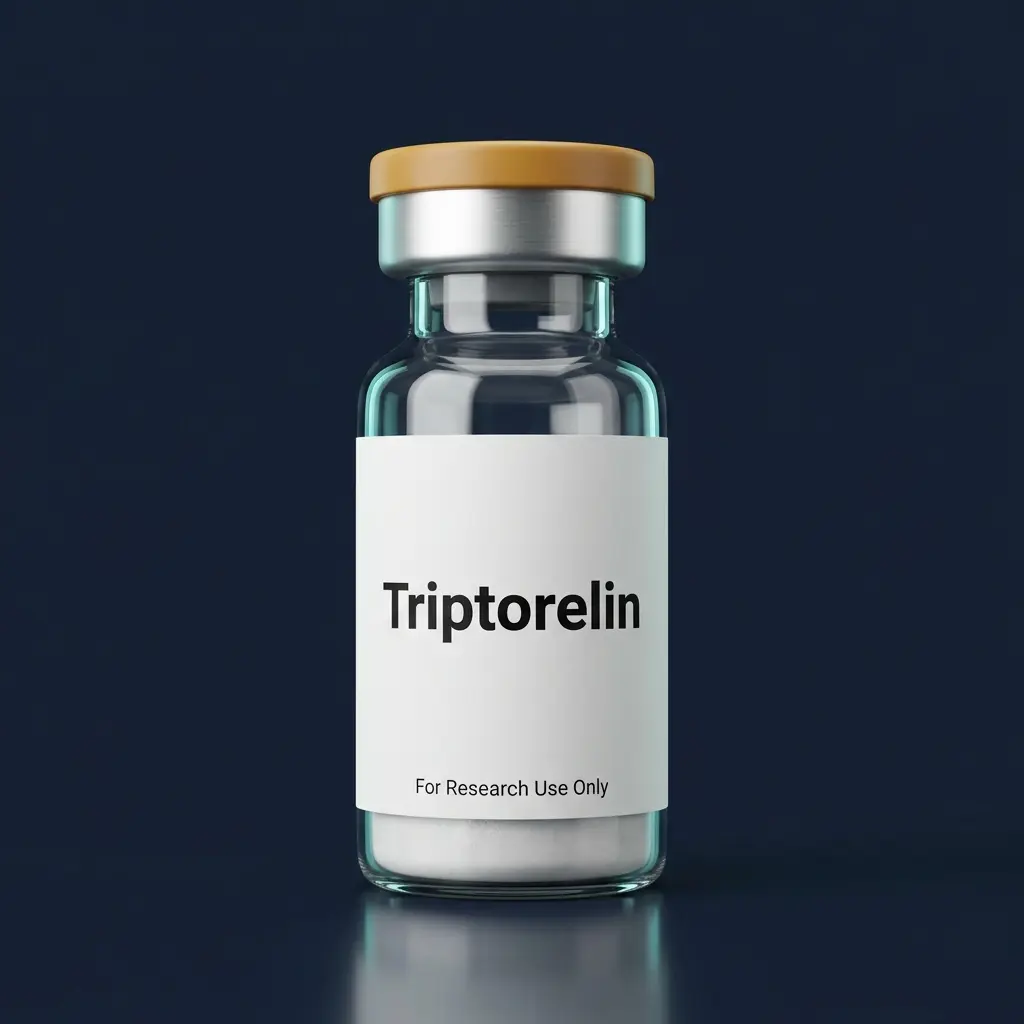
Triptorelin Acetate 2mg
You’re now subscribed to price tracking for this product. We’ll notify you if the price drops.
Fast Delivery
Quick, reliable shipping to any location.
Free & easy returns
Return this item by mail or in store within 90 days for a full refund.
About Triptorelin Acetate 2mg
Triptorelin is a GnRH agonist analogue — a synthetic decapeptide with modifications at positions 6 and 10 of the native GnRH sequence that dramatically increase potency and half-life compared to endogenous GnRH. It is FDA- and EMA-approved for prostate cancer, endometriosis, and central precocious puberty under various brand names. Like all long-acting GnRH agonists, it produces an initial “flare” of LH and FSH (and consequently sex steroids) followed by receptor desensitization and profound gonadotropin suppression — reducing circulating testosterone in men to castrate levels. Each vial contains 2mg.
The mechanism of action is counterintuitive until the receptor biology is understood. GnRH receptors respond to pulsatile stimulation; continuous high-level agonism from a long-acting analogue causes receptor downregulation and uncoupling from intracellular signaling. After 2-4 weeks of continuous exposure, LH and FSH secretion drops dramatically, and consequently so do testosterone and estradiol. This chemical castration is medically equivalent to surgical castration for testosterone-sensitive conditions.
For research applications, triptorelin is used to study GnRH receptor pharmacology, model hypogonadism (chemical castration models), investigate hormone-sensitive tissue biology in the absence of sex steroids, and as a positive control for GnRH agonist effects. The initial flare followed by suppression pattern also makes it useful for timing-controlled endocrine studies.
Specifications
| Parameter | Value |
|---|---|
| Compound | Triptorelin acetate (GnRH agonist analogue) |
| Amount per Vial | 2mg |
| Purity | 99.4% avg (HPLC verified) |
| Format | Lyophilized powder |
| Reconstitution | Sterile water or saline |
| Storage | -20°C; 2-8°C after reconstitution |
Storage
Store at -20°C before reconstitution. Refrigerate at 2-8°C after reconstitution and use within 14 days. Protect from light.
Why does a GnRH agonist suppress testosterone rather than increase it?
This is the paradox of GnRH agonist pharmacology. The pituitary GnRH receptor requires pulsatile stimulation to maintain LH and FSH secretion. When triptorelin provides continuous (rather than pulsatile) stimulation due to its long half-life, GnRH receptors become desensitized — they downregulate and uncouple from signaling. After 2-4 weeks, LH and FSH secretion drops to very low levels, testosterone follows, and the result is chemical castration. The initial “flare” (a brief period of increased LH/FSH/testosterone before desensitization) is clinically important in prostate cancer because it can temporarily worsen symptoms before suppression begins.
How is triptorelin used to create castration models in research?
In animal research, triptorelin (or other long-acting GnRH agonists) administered at sufficient doses produces reliable hypogonadism — very low testosterone — without surgical castration. This “chemical castration” model is useful for studying androgen-dependent processes, testing testosterone replacement or alternative therapies, and investigating testosterone’s role in specific physiological systems. After cessation of triptorelin treatment, endogenous testosterone production recovers (unlike surgical castration), making chemical castration models reversible — useful for before/after study designs.
What is the difference between triptorelin, leuprolide, and goserelin?
All three are GnRH agonist analogues with the same fundamental mechanism of GnRH receptor desensitization and gonadotropin suppression. They differ primarily in modification sites, formulation, and half-life. Triptorelin is available as short-acting (daily injection) and long-acting (monthly/3-monthly depot) formulations. Leuprolide is similar with multiple depot options. Goserelin is formulated exclusively as a subcutaneous implant. For research, the short-acting daily-injection form of triptorelin or leuprolide allows better dose control than depot formulations, where the release kinetics add variability.
Triptorelin is supplied for laboratory research use only. Not approved for general human use outside of licensed therapeutic indications. Handle in compliance with institutional biosafety guidelines.

Reviews
There are no reviews yet.