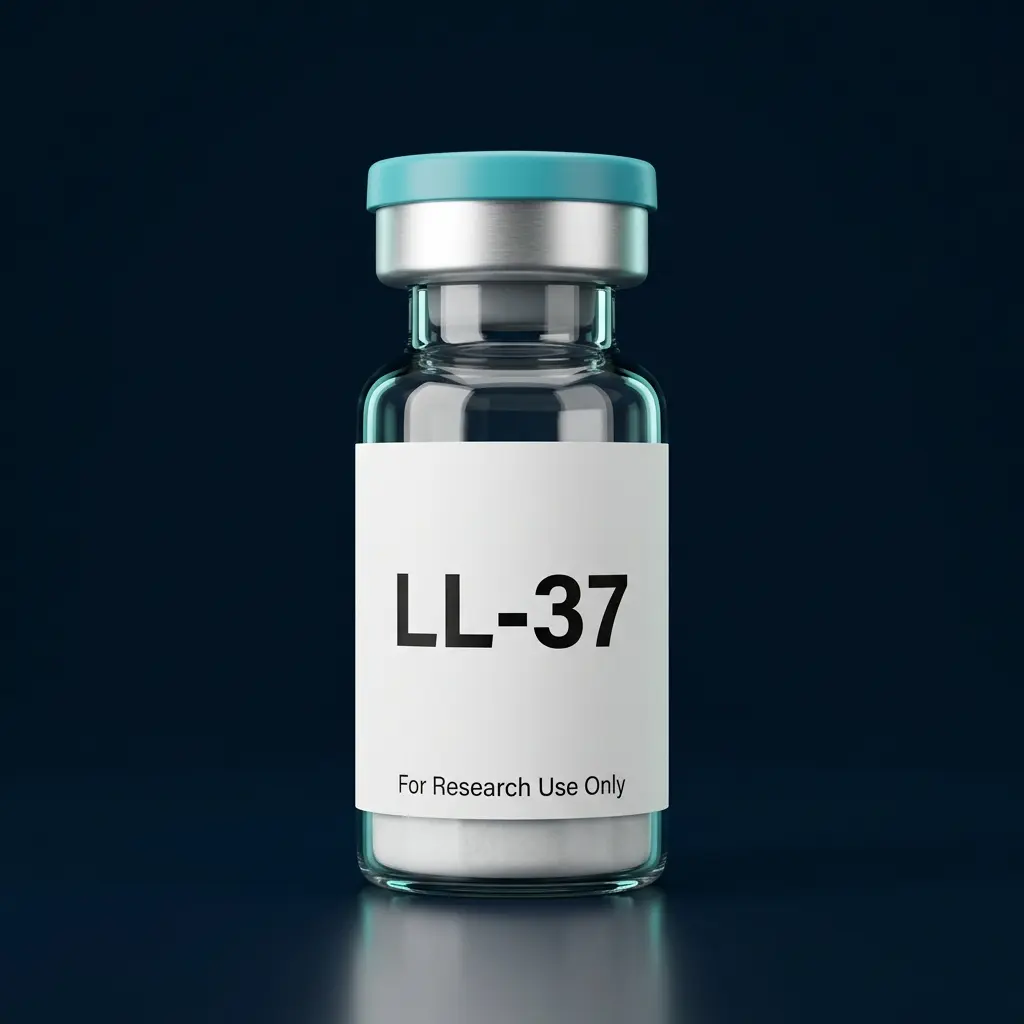
LL-37 5mg
You’re now subscribed to price tracking for this product. We’ll notify you if the price drops.
Fast Delivery
Quick, reliable shipping to any location.
Free & easy returns
Return this item by mail or in store within 90 days for a full refund.
About LL-37 5mg
LL-37 is the only human cathelicidin — a class of host defense peptides that bridge innate immunity and antimicrobial defense. It is derived from the C-terminus of the hCAP-18 protein (human cathelicidin antimicrobial protein 18), processed by serine proteases into the active 37-amino acid LL-37 form. The name reflects its structure: it begins with two leucine residues (LL) and is 37 amino acids long. Despite being the sole human cathelicidin, it is expressed in neutrophils, epithelial cells of the skin, gut, lung, and urogenital tract — providing frontline defense at multiple barrier sites.
LL-37’s antimicrobial mechanism involves disruption of bacterial membranes. Its amphipathic alpha-helical structure allows it to insert into and permeabilize bacterial lipid bilayers, killing a broad spectrum of gram-positive and gram-negative bacteria, fungi, and enveloped viruses. It also binds and neutralizes bacterial LPS (endotoxin), a mechanism studied in models of endotoxin signalling. Beyond direct killing, LL-37 has extensive immunomodulatory functions — it activates epithelial cells, macrophages, and dendritic cells, modulates TLR signaling, and is studied for fibroblast and angiogenesis responses in tissue-repair model systems.
Research interest spans antimicrobial-peptide biology, tissue-repair model systems, skin-barrier-model and lung host-defense research, anti-biofilm strategies, and oncology research (LL-37 has context-dependent pro- and anti-tumor effects in different cancer models).
Specifications
| Parameter | Value |
|---|---|
| Compound | LL-37 (human cathelicidin antimicrobial peptide, 37 aa) |
| Amount per Vial | 5mg |
| Purity | ≥98% (supplier batch specification); selected lots independently tested by Janoshik (HPLC + mass spectrometry), searchable at certapeptides.com/verify |
| Format | Lyophilized powder |
| Reconstitution | Sterile water; avoid high salt concentrations |
| Storage | -20°C; 2-8°C after reconstitution |
Storage
Store at -20°C. LL-37 can aggregate in high ionic strength solutions — reconstitute in low-salt buffer or sterile water and then add buffer. Refrigerate at 2-8°C after reconstitution and use within 14 days. Avoid repeated freeze-thaw.
How does LL-37 kill bacteria without killing host cells?
LL-37 kills bacteria by disrupting their membranes through its amphipathic alpha-helical structure — one face of the helix is hydrophobic, the other cationic. Bacterial membranes are negatively charged due to high phosphatidylglycerol and cardiolipin content, attracting the cationic LL-37. Once bound, the peptide inserts into and permeabilizes the bacterial membrane. Mammalian cell membranes are primarily zwitterionic (net neutral) and are less susceptible to this mechanism, though selectivity is concentration-dependent. High LL-37 concentrations can lyse mammalian cells. Research protocols must account for this concentration-dependent selectivity.
Why is LL-37 the only human cathelicidin?
While mice and many other mammals have multiple cathelicidin genes, humans have only one — the CAMP gene encoding the hCAP-18/LL-37 precursor. The reasons for this reduction to a single cathelicidin in human evolution are not fully understood, but it may relate to immune system specialization in humans toward other defense mechanisms. Despite being alone in its class, LL-37 is expressed at many epithelial surfaces and in immune cells, and its immunomodulatory functions extend well beyond direct antimicrobial killing — suggesting it has evolved to serve multiple host defense roles that might be distributed across multiple cathelicidins in other species.
What is LL-37’s role in tissue-repair model research?
LL-37 is studied for tissue-repair responses in model systems through several mechanisms. In cited models it is associated with keratinocyte migration and proliferation, angiogenesis signalling through VEGF and FGF receptor pathways, and modulation of the inflammatory phase of tissue-repair models, alongside anti-biofilm activity studied in antimicrobial-model systems. These properties have made LL-37 of interest in barrier-model and anti-biofilm research. LL-37-functionalised dressings and scaffolds have also been investigated in tissue-repair model systems.
LL-37 is supplied for laboratory research use only. Not for human use. Handle in compliance with institutional biosafety guidelines.

Reviews
There are no reviews yet.