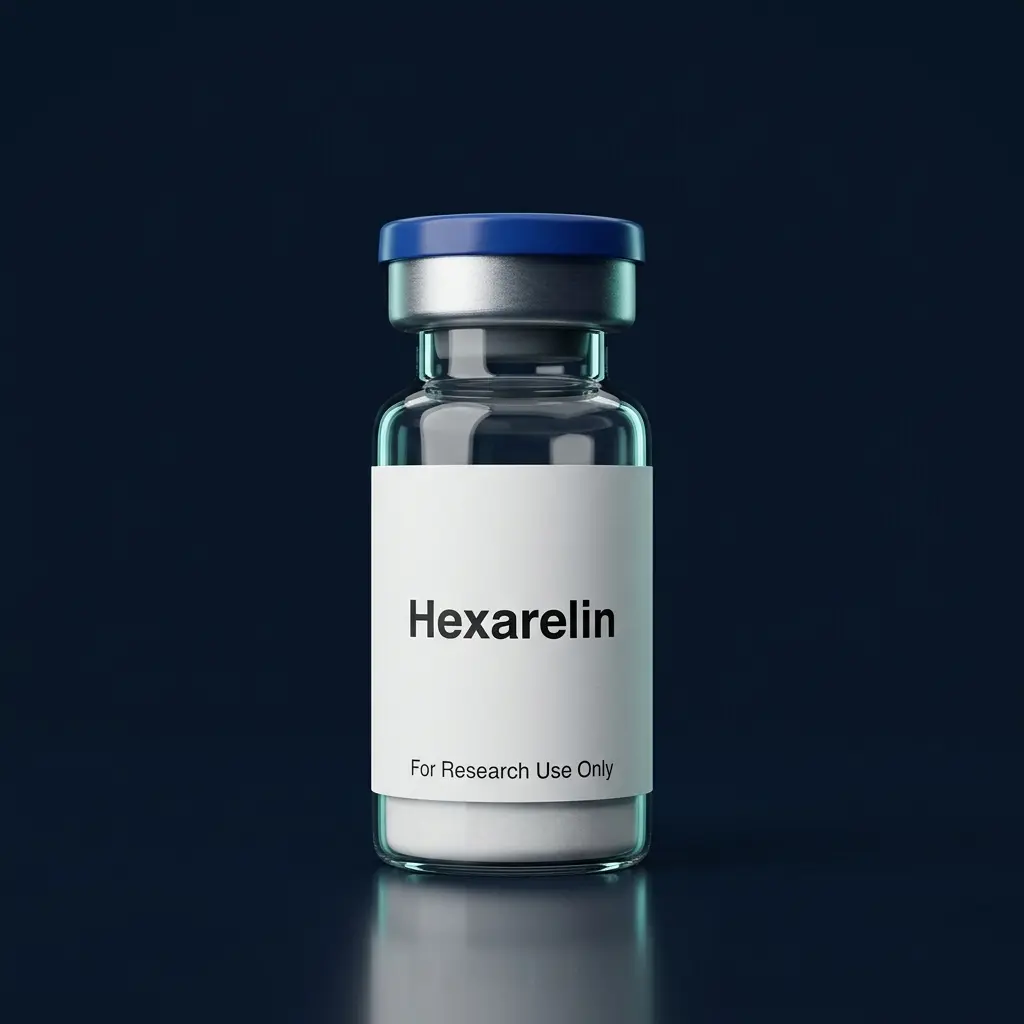
Hexarelin Acetate
You’re now subscribed to price tracking for this product. We’ll notify you if the price drops.
Fast Delivery
Quick, reliable shipping to any location.
Free & easy returns
Return this item by mail or in store within 90 days for a full refund.
About Hexarelin Acetate
Hexarelin is His-D-2-methyl-Trp-Ala-Trp-D-Phe-Lys-NH2 — a synthetic hexapeptide GHS-R1a agonist developed as an analog of GHRP-6, with two structural changes that increase receptor binding affinity and metabolic stability. The result is one of the most potent synthetic GHS peptides in terms of GH release per unit dose. Arvat’s 1997 comparison study ran hexarelin, GHRP-2, GHRP-6, and GHRH side by side in research models. Hexarelin produced the highest GH peak of the group. CAS: 140703-51-1. MW 887.0 Da.
The trade-off for that potency is selectivity. Ipamorelin’s value in research is a clean GHS-R1a signal without off-target effects. Hexarelin doesn’t offer that — it stimulates modest but measurable increases in prolactin, ACTH, and cortisol alongside GH, a consequence of receptor affinity extending to non-somatotroph populations. For experiments where clean GH-axis isolation matters, that’s a limitation. For experiments characterizing the full downstream consequences of potent GHS-R1a activation, it’s the relevant profile.
The Cardiac Signal
Beyond the pituitary, hexarelin has a documented GH-independent cardiac activity. It binds CD36 — a scavenger receptor expressed on cardiomyocytes — through a mechanism distinct from GHS-R1a. This cardiac signaling pathway has been studied in ischemia-reperfusion models, where hexarelin shows cardioprotective effects that persist in GH-deficient animals, confirming the effect is independent of GH axis activation. Two independent receptor systems in one compound: the pituitary GHS-R1a signal and the cardiac CD36 signal. Researchers working in GH pharmacology and those studying cardiac peptide biology can both find use here, though the experimental designs needed to isolate each pathway differ substantially.
Specifications
| Molecular Weight | 887.0 Da |
|---|---|
| Sequence | His-D-2-Me-Trp-Ala-Trp-D-Phe-Lys-NH2 |
| CAS | 140703-51-1 |
| Purity | ≥98% (supplier batch spec; 99.4% avg across independently tested lots) |
| Form | Lyophilized powder |
| Sizes | 2mg, 5mg |
Storage: −20°C, protected from light. Reconstitute in sterile water or 0.1% acetic acid; use within 4 weeks at 4°C.
Quality: Shipped to a ≥98% supplier batch specification; selected lots are independently tested by Janoshik Analytical (HPLC + mass spectrometry; 99.4% average purity across published reports), searchable by batch code at certapeptides.com/verify. EU-based QC under CERTALAB S.R.L.
Frequently Asked Questions
What is hexarelin’s cardiac mechanism?
Hexarelin binds CD36, a scavenger receptor expressed on cardiomyocytes, independently of GHS-R1a. In ischemia-reperfusion models, this produces cardioprotective effects that persist in GH-deficient animals — confirming the effect is not mediated through GH axis activation. The CD36-binding activity is a distinct pharmacological property of hexarelin not shared by other GHRP family members like GHRP-2, GHRP-6, or ipamorelin.
When would you choose hexarelin over GHRP-2 or ipamorelin?
Hexarelin is the right choice when maximum GH stimulation is the goal and off-target effects are acceptable or part of the experimental question. It’s also the appropriate tool for any research on the CD36 cardiac pathway, where neither GHRP-2 nor ipamorelin provides activity. For clean GH research without cortisol or prolactin confounds, ipamorelin is the better choice. For positive controls requiring the highest GH output, hexarelin or GHRP-2 are appropriate depending on how the cortisol/prolactin effects factor into the design.
For research purposes only. Not for human consumption.

Reviews
There are no reviews yet.