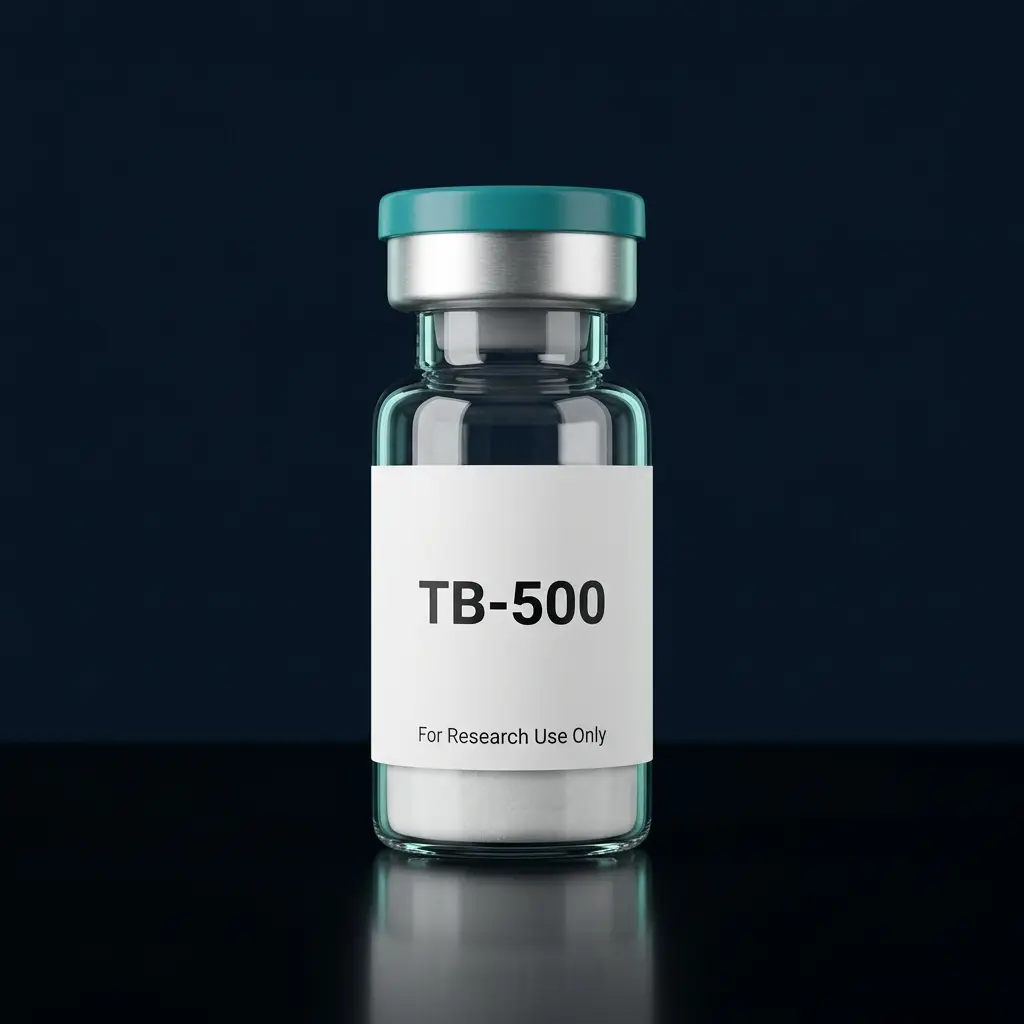
TB-500
You’re now subscribed to price tracking for this product. We’ll notify you if the price drops.
Fast Delivery
Quick, reliable shipping to any location.
Free & easy returns
Return this item by mail or in store within 90 days for a full refund.
About TB-500
TB-500 is a synthetic peptide corresponding to the active region (amino acids 17–23, the Ac-SDKP sequence) of Thymosin Beta-4, a 43-amino acid naturally occurring protein found in virtually all human and animal cells. While the full-length Thymosin Beta-4 protein has broad biological functions, TB-500 specifically retains the key actin-binding domain responsible for the cell migration and tissue biology properties that have drawn significant research interest.
Important distinction: TB-500 is a 17-amino acid fragment of Thymosin Beta-4 — not a synonym for it. Full-length Thymosin Beta-4 (Tβ4, 43 amino acids) has broader systemic activity including immune regulation, while TB-500 isolates the active actin-sequestering region. Researchers should select the appropriate form based on their specific study requirements.
Mechanism of Action
TB-500’s primary studied mechanism is its interaction with G-actin, preventing premature polymerization and enabling organized cell migration in experimental systems. In research models it has been reported to upregulate actin and to promote formation of new blood vessels from existing vasculature, and to reduce levels of pro-inflammatory cytokines and downregulate NF-kB signaling. These observations are reported here for research context only.
Published Research
- Tissue biology and cell migration: Thymosin Beta-4 promotes cell migration through upregulation of actin dynamics, with topical application studied in tissue remodeling in animal models. (DOI)
- Cardiac biology: Thymosin Beta-4 activated epicardial progenitor cells and promoted neovascularization, studied in the context of cardiac tissue remodeling in murine models. (DOI)
- Immunomodulatory properties: Thymosin Beta-4 suppressed NF-kB activation and reduced pro-inflammatory cytokine production in corneal research models. (DOI)
Within the Tissue-Repair Cluster — How TB-500 Differs
TB-500 is studied alongside two other research peptides in overlapping tissue-repair contexts: BPC-157 (a 15-amino-acid pentadecapeptide derived from a gastric-juice protein) and the combined BPC-157 + TB-500 blend. These three compounds share research audiences but operate through different molecular pathways:
| Feature | TB-500 | BPC-157 |
|---|---|---|
| Parent molecule | Thymosin β-4 (43 aa full-length) | BPRP (gastric-juice protein) |
| Amino acid length | 17 (heptadecapeptide, Ac-SDKP containing region) | 15 (pentadecapeptide) |
| Molecular weight | 4963.5 Da | 1419.53 Da |
| Primary mechanism studied | Actin sequestration (LKKTET motif), cell migration, NF-κB suppression | Nitric-oxide pathway, VEGFR2 angiogenesis, mucosal protection |
| Signature preclinical model | Cardiac epicardial progenitor activation (Smart et al., Nature 2011) | Rodent GI mucosa and Achilles transection models |
| Cytoskeletal target | G-actin monomer (direct binding) | Indirect; upstream of angiogenesis pathway |
TB-500’s distinguishing research angle is its direct actin-binding mechanism and cardiac-biology evidence base: it is the only compound in this cluster with published evidence in cardiac epicardial progenitor activation, and the primary research peptide where cytoskeletal dynamics (rather than paracrine signalling) are the central mechanism. Researchers running combined actin-cytoskeletal + nitric-oxide protocols frequently use the BPC-157 + TB-500 blend; for independent dose titration or single-pathway studies, the individual products are preferred. For background reading, see the TB-500 vs BPC-157 comparison, the blend-vs-individual decision guide, and the research peptide stacks guide.
Product Specifications
- Purity: ≥98% (supplier batch spec; 99.4% avg across independently tested lots)
- Form: Lyophilized powder
- CAS: 77591-33-4
- Molecular Weight: 4,963.5 Da
- Sequence Region: Tβ4 active fragment (17 amino acids)
Shipped to a ≥98% supplier batch specification; selected lots are independently tested by Janoshik Analytical (HPLC + mass spectrometry; 99.4% average purity across published reports), searchable by batch code at certapeptides.com/verify.
For research purposes only. Not for human consumption.

Reviews
There are no reviews yet.