Tesamorelin
You’re now subscribed to price tracking for this product. We’ll notify you if the price drops.
Fast Delivery
Quick, reliable shipping to any location.
Free & easy returns
Return this item by mail or in store within 90 days for a full refund.
About Tesamorelin
For research purposes only. Not for human or veterinary use. Not a drug, food, or cosmetic.
Overview
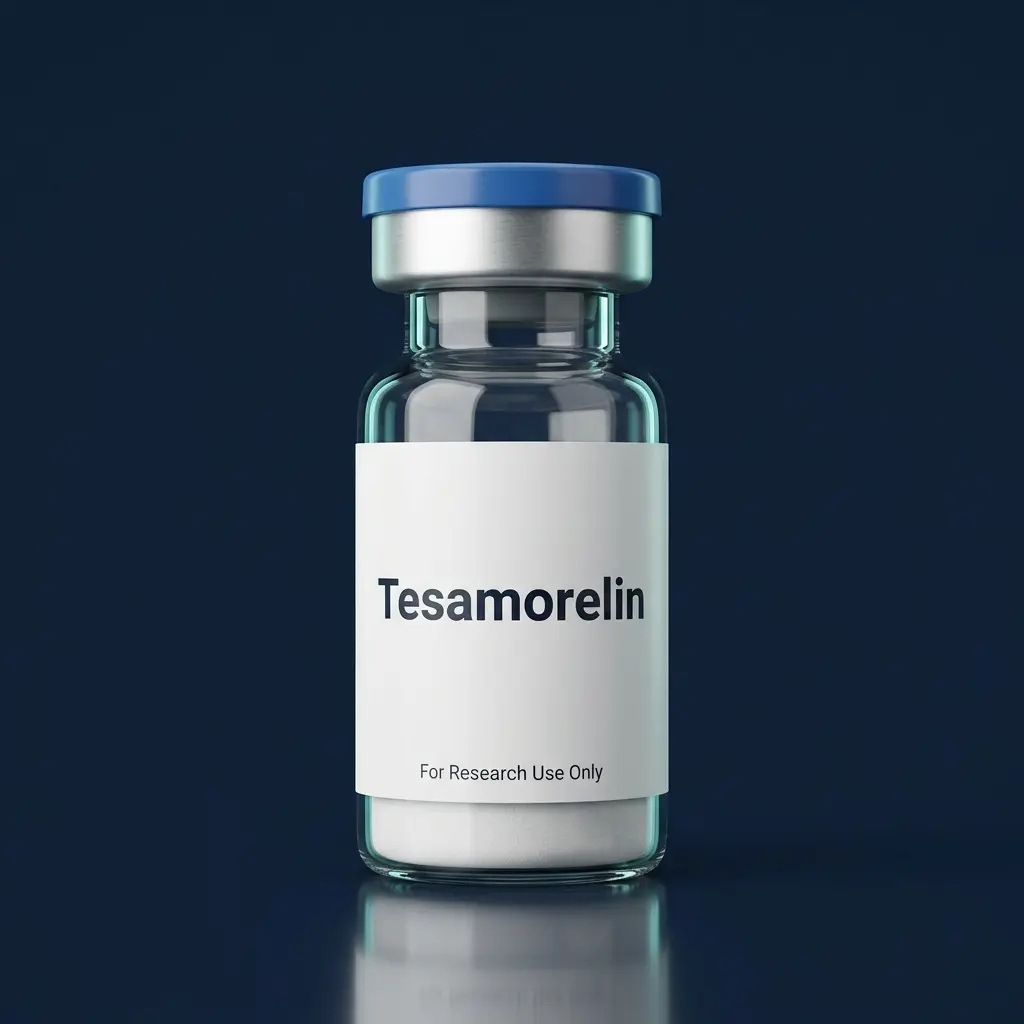
Tesamorelin is a synthetic analog of the full-length human growth-hormone-releasing hormone, GHRH(1–44), carrying a trans-3-hexenoic acid group at the N-terminus that increases receptor-binding stability relative to unmodified GHRH. CAS 218949-48-5; molecular weight 5,135.9 Da. It is one of the most thoroughly characterised GHRH analogs available, which is precisely why researchers reach for it: the supporting pharmacology and clinical-research dataset is deeper than for shorter analogs such as sermorelin (1–29) or CJC-1295.
Mechanistically, tesamorelin follows standard GHRH biology. In research models, activation of the pituitary GHRH receptor is studied for its role in pulsatile GH secretion, downstream IGF-1 signalling, and GH-mediated lipolysis that appears to preferentially engage visceral adipose depots. Tesamorelin is a stabilized analog of the full 44-amino-acid growth-hormone-releasing hormone sequence, carrying an N-terminal modification associated with increased resistance to enzymatic cleavage. CertaPeptides is a reseller and supplies tesamorelin as a research reagent; we do not manufacture or formulate it, and the salt form is as supplied by our source.
Research Areas
The literature around tesamorelin generated endpoints that go well beyond GH and IGF-1, which is what distinguishes it as a research reference compound. A randomised trial in patients with HIV-associated abdominal fat accumulation investigated the metabolic effects of this growth-hormone-releasing factor, using visceral adipose tissue as a measured endpoint (Falutz et al., 2007). A later randomised study examined effects on both visceral fat and liver fat, quantifying hepatic fat as a distinct outcome (Stanley et al., 2014). That combination — MRI-measured visceral adiposity plus liver-fat quantification — is more developed for tesamorelin than for other GHRH analogs, which is why it recurs in visceral-adiposity, NAFLD-model, and metabolic-pathway research. For studies requiring a well-characterised GHRH reference, tesamorelin is the appropriate choice.
Specifications
| Molecular Weight | 5,135.9 Da |
|---|---|
| CAS | 218949-48-5 |
| Purity | ≥98% (supplier batch specification) |
| Form | Lyophilized powder |
| Sizes | 2mg, 5mg, 10mg, 20mg |
| Storage | −20°C lyophilized; 2–8°C after reconstitution, use within 4 weeks |
Quality & Verification
Every unit ships to a ≥98% supplier batch specification. In addition, selected lots are independently tested by Janoshik Analytical (HPLC and mass spectrometry), and those reports are searchable by batch code at certapeptides.com/verify. We make no in-house testing claim and do not test every batch — the two-tier approach is intentional: a baseline supplier specification on all units, plus third-party reports on selected lots. EU-based handling and fulfilment under CERTALAB S.R.L.
Frequently Asked Questions
What makes tesamorelin different from sermorelin?
Sermorelin is GHRH(1–29) — the first 29 of the 44 residues. Tesamorelin is the full 44-amino-acid sequence with an N-terminal modification associated with increased stability. Tesamorelin also carries a far more developed research dataset, including visceral-fat and liver-fat endpoints that sermorelin lacks.
Why is tesamorelin associated with visceral fat research specifically?
In research models, tesamorelin’s GH-driven lipolysis is studied for preferentially engaging visceral adipose tissue rather than subcutaneous depots. Trials characterising the compound used MRI-measured visceral fat as a primary endpoint (Falutz et al., 2007), which is why it features prominently in visceral-adiposity and metabolic-pathway investigation.
How is tesamorelin stored?
Keep the lyophilized powder at −20°C, away from light. After reconstitution, store at 2–8°C and use within about four weeks. As a full-length peptide it is sensitive to repeated temperature cycling, so minimise freeze-thaw of the reconstituted solution.
Why does the full 44-residue sequence matter?
Tesamorelin retains the full 44-amino-acid GHRH sequence with an N-terminal modification; the structural description here is limited to sequence and stability, not comparative potency claims.
What endpoints has tesamorelin research measured?
Beyond GH and IGF-1, the published research has measured MRI-quantified visceral adipose tissue, hepatic (liver) fat, and lipid/metabolic biomarkers (Stanley et al., 2014). This breadth of characterisation is what makes tesamorelin a useful reference tool for metabolic and adiposity research.
For research purposes only. Not for human consumption.

Reviews
There are no reviews yet.