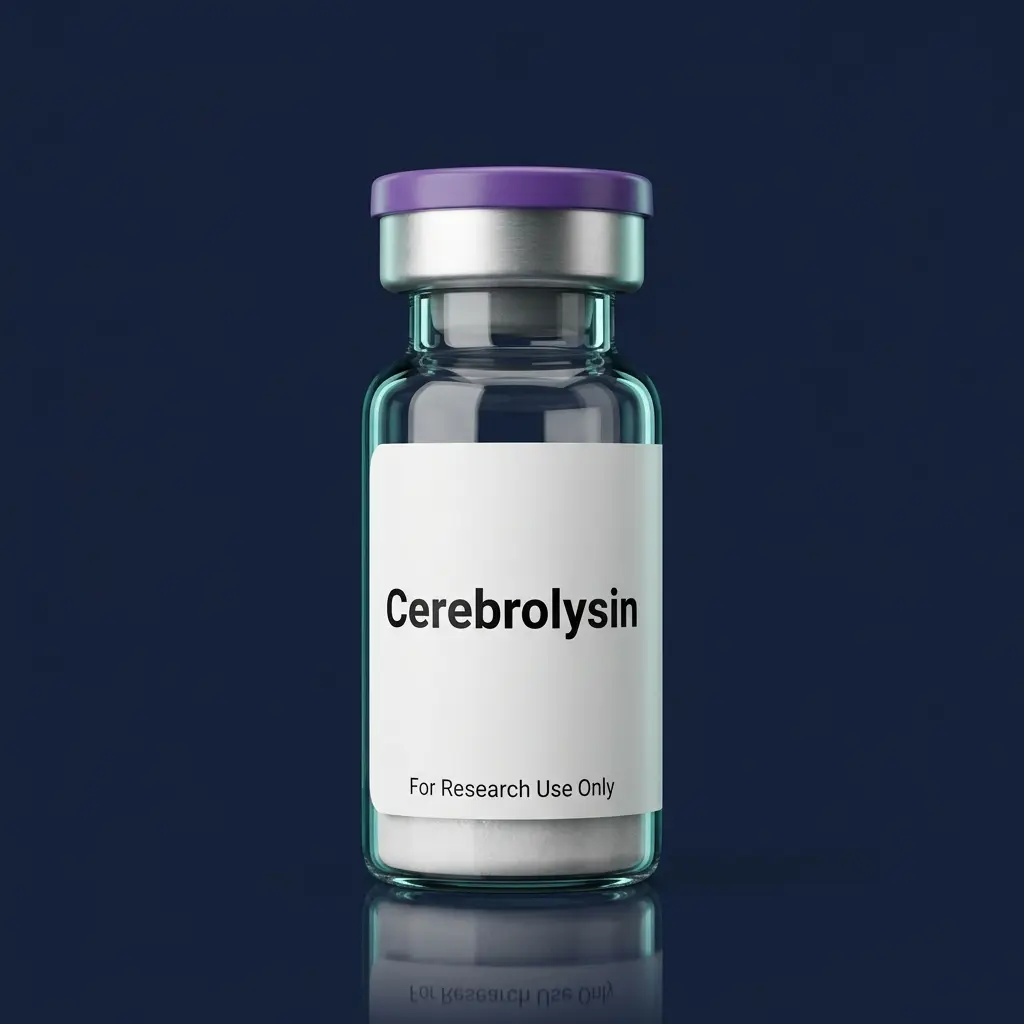
Cerebrolysin 60mg
You’re now subscribed to price tracking for this product. We’ll notify you if the price drops.
Fast Delivery
Quick, reliable shipping to any location.
Free & easy returns
Return this item by mail or in store within 90 days for a full refund.
About Cerebrolysin 60mg
Cerebrolysin is a multi-peptide brain-derived neurotrophic preparation consisting of enzymatically treated porcine brain protein. The preparation contains a mixture of low-molecular-weight neuropeptides and free amino acids that cross the blood-brain barrier. It has an unusually long history for a peptide complex and has been studied in the context of neurological injury models including ischemic, traumatic, and vascular insults — and has been characterised since the 1970s. Each vial contains 60mg of the lyophilized preparation.
The active components of Cerebrolysin are not fully defined chemically, which distinguishes it from single-compound neurotrophic peptides. The preparation has demonstrated neurotrophic factor-like activity in cell culture and animal models: it promotes neuronal survival, enhances synaptic plasticity, stimulates neurogenesis, and exhibits neuroprotective effects in various injury models. Preclinical and in-vitro studies have examined its effects on recovery and cognitive parameters in injury and neurodegeneration models, with variable results across study designs. The European Medicines Agency has characterised it within some neurological research contexts.
For research purposes, Cerebrolysin is a useful tool for studying multi-factor neurotrophic support — where the combined effect of multiple small peptides may recapitulate some of the biological activity of endogenous neurotrophic factors (BDNF, NGF, GDNF) more completely than any single defined compound.
Specifications
| Parameter | Value |
|---|---|
| Compound | Cerebrolysin (porcine brain-derived neuropeptide complex) |
| Amount per Vial | 60mg lyophilized |
| Composition | Low-MW neuropeptides + free amino acids from porcine brain proteins |
| Format | Lyophilized powder |
| Reconstitution | Sterile water or saline |
| Storage | 2-8°C; use within 14 days after reconstitution |
Storage
Store at 2-8°C (refrigerator) as lyophilized powder. Refrigerate after reconstitution and use within 14 days. As a biological preparation, avoid freezing and thawing cycles.
What makes Cerebrolysin different from a single neurotrophic peptide?
Single neurotrophic peptides (like BDNF or NGF) target specific receptors. Cerebrolysin contains a mixture of multiple small peptides and amino acids that together mimic aspects of the brain’s complex neurotrophic environment. In research, this can be advantageous when the goal is broad neuroprotection or neurogenesis stimulation rather than receptor-specific pharmacology. The trade-off is that the mixture composition is not fully defined, which limits mechanistic interpretation. Cerebrolysin is better suited for studies where the preparation itself is the research focus, or for generating hypotheses that can then be pursued with defined single compounds.
How does Cerebrolysin penetrate the blood-brain barrier?
Cerebrolysin’s active components are specifically the low-molecular-weight fraction (peptides under approximately 10 kDa) — the preparation is enzymatically processed to ensure these small peptides predominate. Small peptides can cross the blood-brain barrier through passive diffusion (if sufficiently lipophilic), transcytosis, or active transport. The preparation is documented to produce measurable CNS effects after systemic IV or IM administration in preclinical models, indicating at least partial CNS delivery. The full pharmacokinetics of the mixed preparation are complex to characterize precisely.
What are the main research areas for Cerebrolysin?
The most-studied research area for Cerebrolysin is ischemic injury models — preclinical work has examined neurological outcome parameters when administered early in models of ischemic insult. Neurodegeneration models have examined cognitive parameters in some studies but not consistently across designs. Traumatic injury models have been another focus, with preclinical data examining neuroprotection. The research base is heterogeneous in quality, and the compound is characterised differently across regulatory jurisdictions.
Cerebrolysin is supplied for laboratory research use only. Not for human consumption. Handle in compliance with institutional biosafety guidelines.

Reviews
There are no reviews yet.