BPC-157 + TB-500 Blend
You’re now subscribed to price tracking for this product. We’ll notify you if the price drops.
Fast Delivery
Quick, reliable shipping to any location.
Free & easy returns
Return this item by mail or in store within 90 days for a full refund.
About BPC-157 + TB-500 Blend
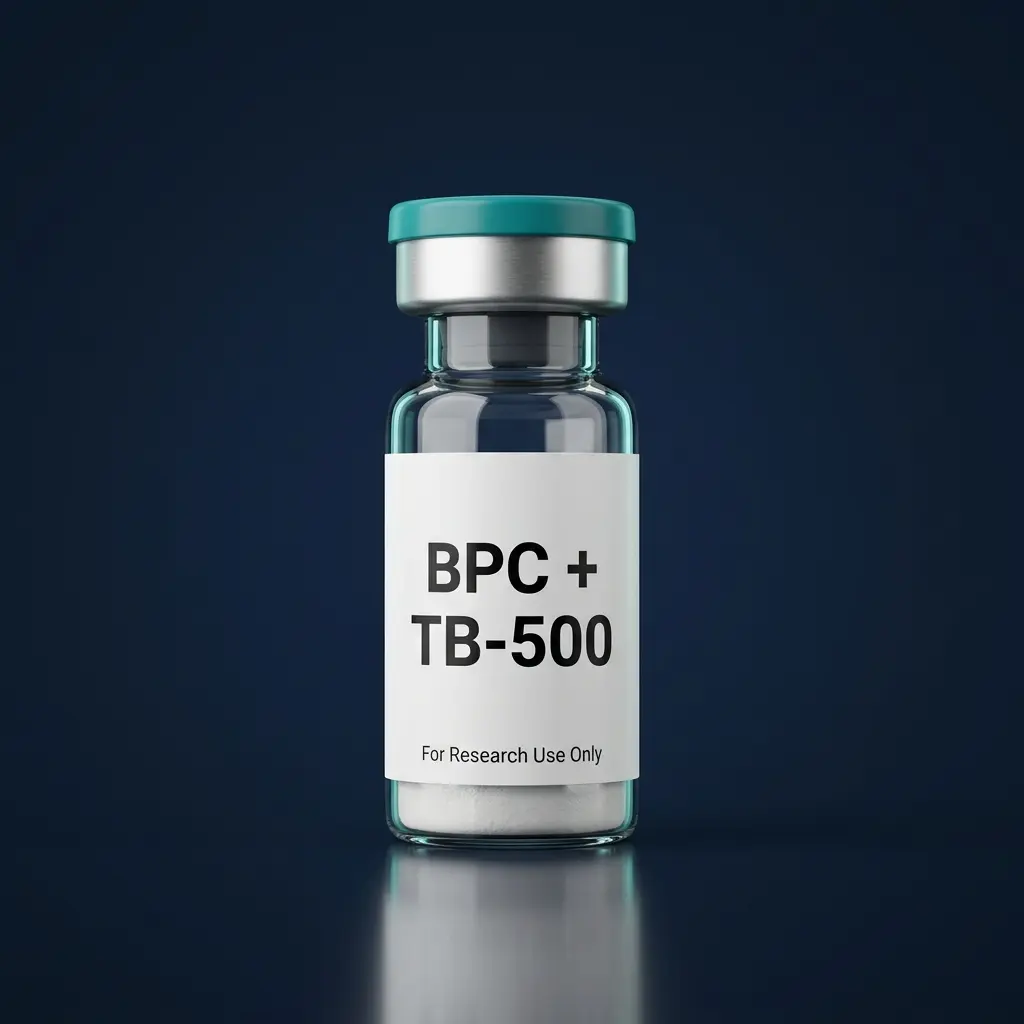
BPC-157 + TB-500 is the injectable blend combining two of the most widely researched tissue repair peptides. BPC-157 (Body Protection Compound-157) is a 15-amino acid peptide with documented stability in gastric conditions and well-replicated effects on GI mucosal protection, tendon healing, and nitric oxide pathway modulation. TB-500 is the 17-amino acid LKKTET-containing fragment of thymosin beta-4, responsible for actin cytoskeleton regulation, cell migration, and anti-inflammatory signaling. Each vial contains 5mg BPC-157 and 5mg TB-500 (10mg total).
The rationale for combining them is mechanistic complementarity. BPC-157 primarily modulates the nitric oxide system, promotes angiogenesis through VEGFR2 signaling, and protects mucosal surfaces. TB-500 acts through actin dynamics and cell migration — it promotes the cell movement needed for tissue remodeling and repair. Both have been studied in overlapping contexts (fibroblast proliferation in cited models, tendon repair, muscle injury), but through different enough mechanisms that combination research is scientifically justified. Some published studies have examined co-administration and found additive effects in certain models, though the mechanistic basis for interaction is not fully established.
For researchers choosing between the blend and separate products: the blend fixes the ratio at 1:1 (5mg each), which may not match all research protocols. Separate products give independent dose control. The blend is convenient for studies where the fixed combination is appropriate or where exploring the combination effect is the primary interest.
Within the Tissue-Repair Cluster — How the Blend Differs
The BPC-157 + TB-500 blend sits alongside the two standalone research peptides in CertaPeptides’ tissue-repair cluster: BPC-157 and TB-500. The primary distinction between buying the blend versus the two individual peptides is ratio control versus administration simplicity:
| Scenario | Blend (this product) | Separate products |
|---|---|---|
| Fixed ratio | 1:1 (5mg : 5mg per vial) | Researcher-defined ratio |
| Reconstitution events | One vial per dose | Two vials per dose |
| Dose-response experiments | Limited — both components vary together | Each peptide titrated independently |
| Isolated-pathway studies | Not suitable — both peptides always present | Single-peptide protocols possible |
| Appropriate when | Studying the combination effect; established 1:1 protocol; logistics matter | Mechanism isolation; dose-response; one peptide is the primary interest |
Researchers choosing between the blend and separate products frequently reference the BPC-157 vs TB-500 vs blend decision guide, the TB-500 vs BPC-157 comparison, and the broader research-peptide stacks overview.
Research Applications
Used in tissue repair and healing research, musculoskeletal injury models, GI mucosal biology, nitric oxide pathway studies, and combination peptide pharmacology. Also used to investigate whether BPC-157’s established oral bioavailability extends to any systemic effects that parallel those seen with injectable TB-500.
Specifications
| Parameter | Value |
|---|---|
| Component 1 | BPC-157 5mg (CAS 137525-51-0) |
| Component 2 | TB-500 5mg (Thymosin Beta-4 fragment) |
| Total per Vial | 10mg combined |
| Purity | ≥98% per component (supplier batch spec; 99.4% avg across independently tested lots) |
| Format | Lyophilized powder, single-use vial |
| Storage | -20°C before reconstitution; 2-8°C after |
Storage
Store unreconstituted vials at -20°C. After reconstitution with bacteriostatic water, refrigerate at 2-8°C and use within 28 days. Avoid repeated freeze-thaw of reconstituted solution.
What is the research basis for combining BPC-157 and TB-500?
BPC-157 and TB-500 work through different but complementary pathways. BPC-157 modulates the nitric oxide system, promotes angiogenesis through VEGFR2 signaling, and shows strong GI mucosal protection. TB-500 regulates actin dynamics, promotes cell migration and proliferation, and has anti-inflammatory effects. Both have been studied in healing and repair contexts. The combination hypothesis is that addressing both vascular/mucosal protection (BPC-157 territory) and cellular motility required for tissue remodeling (TB-500 territory) may produce better outcomes than either alone, though this needs study-specific verification.
Why use the blend vs separate BPC-157 and TB-500 products?
The blend is convenient when a 1:1 ratio (5mg each) matches the research protocol and the goal is studying the combination effect. Separate products provide independent dose control — essential when testing different ratios, conducting dose-response experiments, or when one peptide is the primary interest. The blend also means one reconstitution and one administration per dosing event. For exploratory studies or established protocols using both peptides, the blend simplifies logistics.
How is this product reconstituted?
Reconstitute with bacteriostatic water (preservative helps with stability after opening) or sterile water for single-use protocols. The lyophilized cake should dissolve clear within a few minutes — avoid vigorous shaking, which can denature peptides. For storage after reconstitution, keep at 2-8 degrees C and use within 28 days. Calculate volume based on the total peptide content (10mg) and your target concentration.
BPC-157 + TB-500 Blend is supplied for laboratory research use only. Not approved for human use. Handle in compliance with institutional biosafety guidelines.

Reviews
There are no reviews yet.