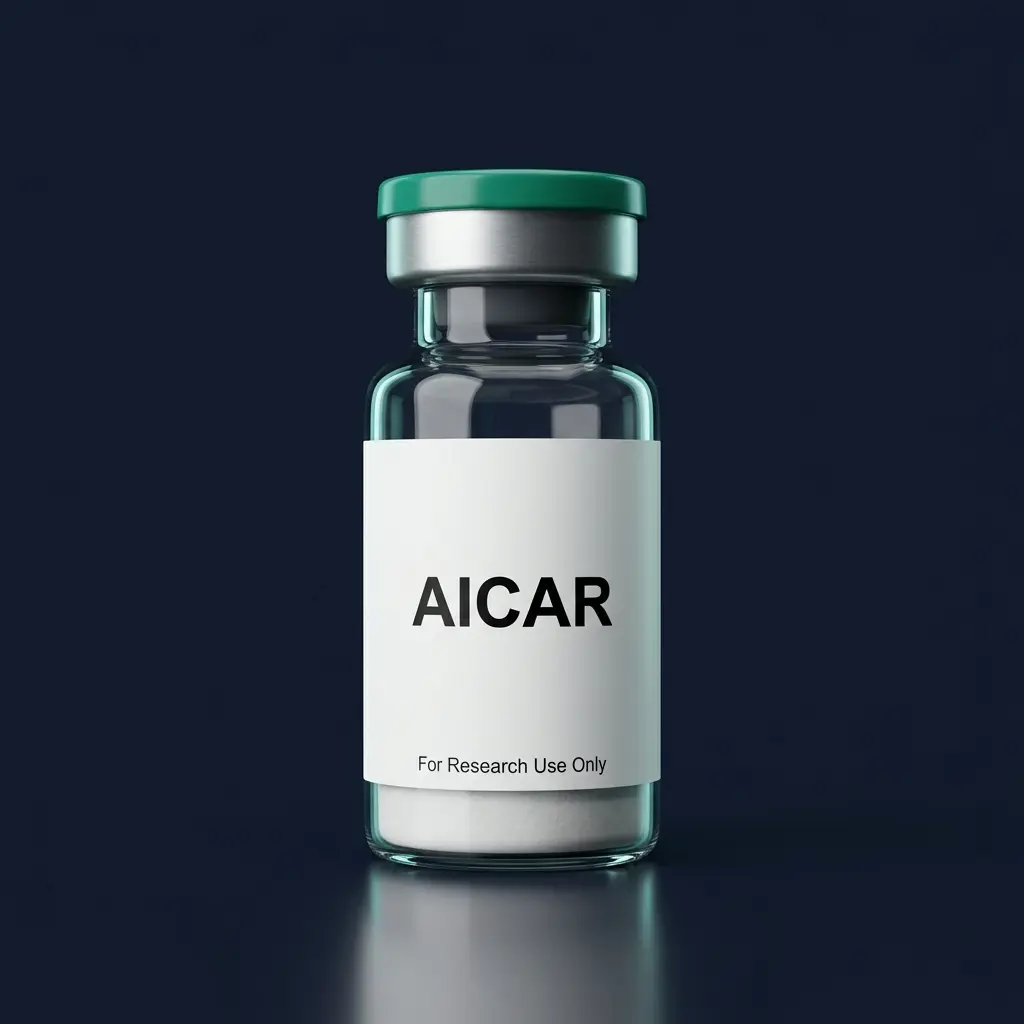
AICAR
You’re now subscribed to price tracking for this product. We’ll notify you if the price drops.
Fast Delivery
Quick, reliable shipping to any location.
Free & easy returns
Return this item by mail or in store within 90 days for a full refund.
About AICAR
AICAR (5-Aminoimidazole-4-carboxamide ribonucleoside, or acadesine) is an adenosine monophosphate (AMP) analogue that activates AMPK — AMP-activated protein kinase, the cell’s central energy sensor. When cellular energy is low (high AMP:ATP ratio), AMPK activates and triggers a suite of adaptive responses in research models: increased glucose uptake, enhanced fatty acid oxidation, suppression of energy-consuming biosynthetic pathways, and — over time — mitochondrial biogenesis. AICAR mimics energy depletion by being phosphorylated intracellularly to ZMP, which activates AMPK without actually reducing ATP.
AICAR’s role in exercise mimetic research comes from the fact that AMPK activation recapitulates some of the metabolic adaptations of endurance exercise in research models. The compound was famously added to WADA’s prohibited list in 2011 based on these properties, even before a validated detection method existed. In research, it serves as the standard pharmacological tool for studying AMPK-mediated metabolic pathways — more selective and interpretable than AMP itself, which has broader and shorter-lived effects.
AICAR also has established cardioprotective effects in ischemia/reperfusion models and has been studied in oncology research for its effects on cancer cell metabolism. The hematological malignancy literature is particularly developed: AICAR induces apoptosis in certain leukemia and lymphoma cells through AMPK-dependent and -independent mechanisms.
Research Applications
AICAR is used as a standard AMPK activator for metabolic research, in exercise physiology and exercise mimetic studies, cardiac ischemia/reperfusion protection models, oncology metabolic research (particularly hematological malignancies), and as a comparator to other metabolic pathway activators like SLU-PP-332 and SR9009.
Specifications
| Parameter | Value |
|---|---|
| Compound | AICAR (5-Aminoimidazole-4-carboxamide ribonucleoside) |
| CAS Number | 2627-69-2 |
| Purity | ≥98% (supplier batch spec; 99.4% avg across independently tested lots) |
| Format | Lyophilized powder |
| Reconstitution | Sterile water or PBS |
| Storage | -20°C, protect from moisture |
Storage
Store at -20°C in a sealed container protected from moisture. AICAR is hygroscopic — absorbs water from air. Keep desiccated. Reconstituted solutions are stable at 4°C for up to 1 week; longer-term, store aliquots at -20°C.
How does AICAR activate AMPK without reducing ATP?
AICAR is taken up by cells and phosphorylated by adenosine kinase to form ZMP (AICAR monophosphate). ZMP mimics AMP structurally and binds to the regulatory sites on AMPK that normally sense AMP, allosterically activating the kinase. Importantly, ZMP cannot be converted to ADP or ATP, so it accumulates and provides persistent AMPK activation without the cell actually running out of energy. This pharmacological mimicry is what makes AICAR a research tool — it separates AMPK activation from the physiological context of energy depletion.
Why is AICAR banned in sports if it’s a research compound?
WADA banned AICAR in 2011 because preclinical research, including well-publicized mouse studies, showed that AMPK activation improves endurance and activates exercise adaptation pathways in research models. The ban was preemptive — before robust evidence of doping use or even a validated detection test existed. AICAR represents a category of compounds that WADA has increasingly banned based on pharmacological mechanism rather than documented performance enhancement in athletes. For research purposes, these substances remain important scientific tools studied for metabolic disease, cardiac protection, and oncology.
What is AICAR’s relationship to the cancer research literature?
AICAR has a substantial cancer research literature, particularly for hematological malignancies. In chronic lymphocytic leukemia (CLL) and certain lymphoma models, AICAR induces apoptosis through mechanisms that include AMPK activation, but also through AMPK-independent effects on purine synthesis and DNA metabolism. The anti-proliferative effects in cancer cells relate to AICAR’s ability to disrupt purine nucleotide synthesis (an essential nutrient for rapidly dividing cells) in addition to its AMPK-activating properties. This dual mechanism makes AICAR a useful tool for separating AMPK-dependent from metabolic effects in cancer biology research.
AICAR is supplied for laboratory research use only. Not approved for human use. Handle in compliance with institutional biosafety guidelines.

Reviews
There are no reviews yet.