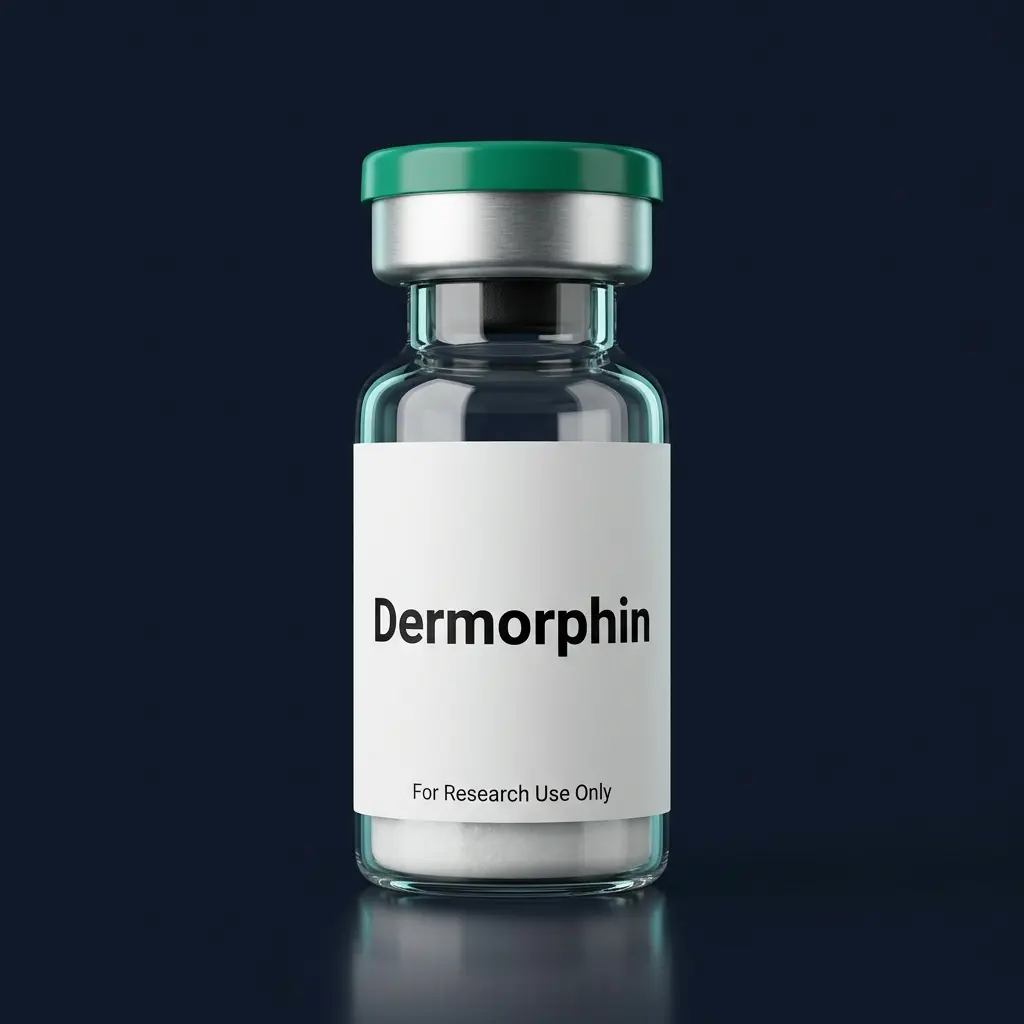
Dermorphin
You’re now subscribed to price tracking for this product. We’ll notify you if the price drops.
Fast Delivery
Quick, reliable shipping to any location.
Free & easy returns
Return this item by mail or in store within 90 days for a full refund.
About Dermorphin
Dermorphin is a heptapeptide opioid first isolated from the skin secretions of South American frogs of the genus Phyllomedusa in 1981. It is a selective mu-opioid receptor agonist with approximately 1,000 times the analgesic potency of morphine in some assays — among the most potent naturally occurring opioid peptides known. What makes dermorphin pharmacologically unusual is that it contains a D-amino acid (D-alanine at position 2), which gives it resistance to peptidase degradation and contributes to its high potency and prolonged activity compared to endorphins.
The D-amino acid is particularly noteworthy because D-amino acids are rare in naturally occurring proteins — virtually all biological proteins use L-amino acids. Dermorphin’s D-alanine is incorporated through a post-translational epimerization step, demonstrating that some organisms have evolved enzymes to convert L-amino acids to D-form during peptide maturation. This natural occurrence of D-amino acid incorporation in a pharmacologically active peptide has made dermorphin interesting both for opioid pharmacology and for biochemical research into D-amino acid biology.
Research applications include opioid receptor pharmacology, mu-receptor subtype characterization, pain neuroscience, and investigation of D-amino acid effects on peptide stability and receptor binding.
Specifications
| Parameter | Value |
|---|---|
| Compound | Dermorphin (mu-opioid heptapeptide from Phyllomedusa frogs) |
| Purity | ≥ 98% (supplier batch spec; 99.4% avg across independently tested lots) |
| Format | Lyophilized powder |
| Reconstitution | Sterile water or saline |
| Storage | -20°C; 2-8°C after reconstitution |
Storage
Store at -20°C before reconstitution. Refrigerate at 2-8°C after reconstitution and use within 28 days. Dermorphin’s D-amino acid content makes it more resistant to protease degradation than typical peptides — good stability under proper storage conditions.
Why does the D-amino acid in dermorphin make it special?
D-alanine at position 2 of dermorphin serves two functions. First, it contributes to mu-opioid receptor binding geometry — the D-configuration allows the peptide backbone to adopt a conformation that fits the receptor binding site with high affinity. This contributes to dermorphin’s exceptional potency. Second, D-amino acids are resistant to most mammalian peptidases, which are stereospecific for L-amino acids. This resistance slows degradation and extends dermorphin’s activity compared to endorphins with the same receptor affinity. Together these properties explain why a frog skin peptide achieves opioid potency orders of magnitude above morphine.
What are dermorphin’s research applications in opioid pharmacology?
Dermorphin serves as a high-affinity mu-opioid receptor tool compound, useful for receptor binding assays, pharmacological characterization of mu-receptor subtypes (mu1 vs. mu2), autoradiography studies of opioid receptor distribution, and as a positive control in opioid receptor assays. Its exceptional potency makes it useful at very low concentrations. Dermorphin analogues have also been developed as templates for novel analgesic design, and studying dermorphin’s pharmacophore has contributed to understanding what structural features drive mu-receptor selectivity and potency.
How was dermorphin discovered in frog skin?
Dermorphin was discovered in 1981 by Vittorio Erspamer’s group in Rome, who had systematically studied the pharmacological properties of skin secretions from South American phyllomedusine frogs for decades. Erspamer’s laboratory is responsible for identifying multiple bioactive peptides from amphibian skin (including bombesin, caerulein, and physalaemin). Phyllomedusa sauvagii skin secretions showed opioid-like activity in bioassays, and the active peptide was isolated and characterized as a novel heptapeptide with the remarkable D-amino acid in position 2. The discovery prompted investigation into how organisms incorporate D-amino acids into peptides — a question that later revealed the epimerization enzymes responsible.
Dermorphin is supplied for laboratory research use only. Not approved for human use. Handle in compliance with institutional biosafety guidelines.

Reviews
There are no reviews yet.