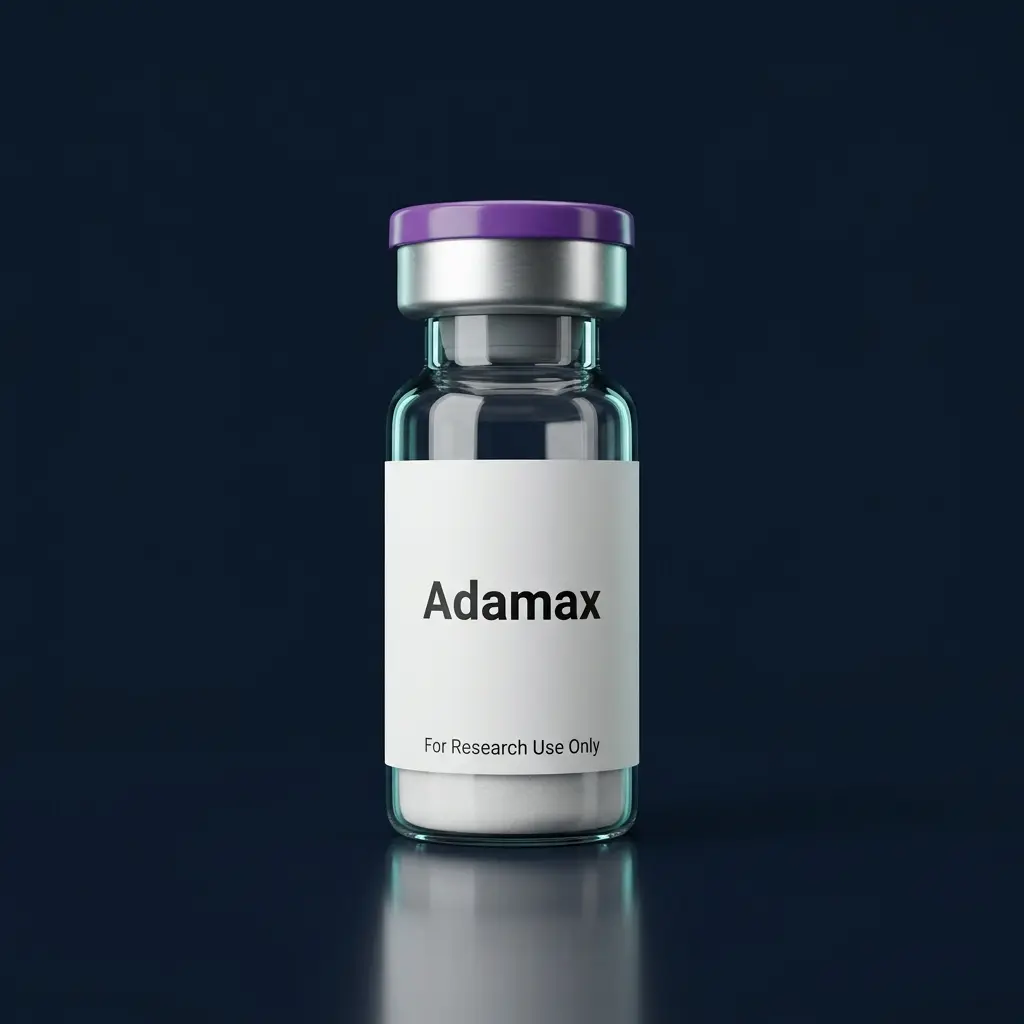
Adamax 5mg
You’re now subscribed to price tracking for this product. We’ll notify you if the price drops.
Fast Delivery
Quick, reliable shipping to any location.
Free & easy returns
Return this item by mail or in store within 90 days for a full refund.
About Adamax 5mg
Adamax is a synthetic neuropeptide fragment based on the vasopressin analogue family, designed with modifications for improved CNS activity and stability. It is used in cognitive neuroscience research, particularly in memory consolidation and retrieval studies. The vasopressin-related peptides have a long history in memory research going back to the 1970s, when DeWied’s group showed that vasopressin and its fragments influence avoidance learning and memory in rodents through CNS mechanisms distinct from vasopressin’s peripheral endocrine roles (antidiuretic, vasoconstrictor).
Adamax’s research context is the posterior pituitary neuropeptide family — vasopressin (AVP) and oxytocin — which have extensive CNS projections distinct from their pituitary hormonal release. These neuropeptides modulate hippocampal and amygdalar circuits relevant to memory encoding, social recognition memory, and stress responses. Modified short-chain fragments of vasopressin (like VP4-8, the parent compound of the adamax family) retain memory-influencing properties with reduced peripheral hormonal effects, making them more useful for isolating CNS cognitive effects.
Research applications include spatial and associative memory studies in rodents, investigations into vasopressin system contributions to CNS receptor binding markers, stress-memory interactions, and as a positive control for vasopressin-family peptide research.
Specifications
| Parameter | Value |
|---|---|
| Compound | Adamax (vasopressin-derived cognitive nootropic peptide) |
| Amount per Vial | 5mg |
| Purity | 99.4% avg (HPLC verified) |
| Format | Lyophilized powder |
| Reconstitution | Sterile water or saline |
| Storage | -20°C; 2-8°C after reconstitution |
Storage
Store at -20°C before reconstitution. Refrigerate at 2-8°C after reconstitution and use within 28 days. Stable lyophilized for 24+ months under proper storage.
What is the historical basis for vasopressin-derived peptides in memory research?
The connection between vasopressin and memory originates from work by David DeWied and colleagues in the 1970s-80s, who showed that vasopressin administered peripherally or centrally improved performance in avoidance learning tests in rats, while vasopressin-deficient (Brattleboro) rats showed memory impairments that could be reversed by vasopressin treatment. Subsequent work identified that short fragments of vasopressin (particularly C-terminal fragments like VP4-8) retained memory-facilitating properties without peripheral hormonal effects, suggesting these effects were mediated by CNS receptors. This research tradition led to development of modified fragments like those in the adamax family.
How does vasopressin affect memory in the brain?
Vasopressin V1a receptors are expressed in the hippocampus, amygdala, septum, and other limbic structures involved in memory encoding and consolidation. Vasopressin acts as a neuromodulator in these circuits, influencing synaptic plasticity and the encoding of emotionally significant or aversive events. It enhances memory consolidation for avoidance tasks and influences social recognition memory through amygdala V1a signaling. The stress-memory interaction is also relevant: vasopressin release during stress may help encode stress-related memories, which connects vasopressin research to PTSD-related neuroscience.
What memory tasks are used to study peptides like Adamax in rodents?
Common tasks include passive avoidance (one-trial learning with a foot shock), active avoidance, Morris water maze (spatial memory), novel object recognition, and social recognition memory. These tasks have established sensitivity to vasopressin-system interventions. The passive avoidance test is particularly associated with the DeWied vasopressin memory literature because vasopressin fragments robustly improve retention in this paradigm. For researchers studying memory peptides, choosing the appropriate behavioral assay for the memory system of interest (hippocampus-dependent, amygdala-dependent, etc.) is important for interpretable results.
Adamax is supplied for laboratory research use only. Not approved for human use. Handle in compliance with institutional biosafety guidelines.

Reviews
There are no reviews yet.